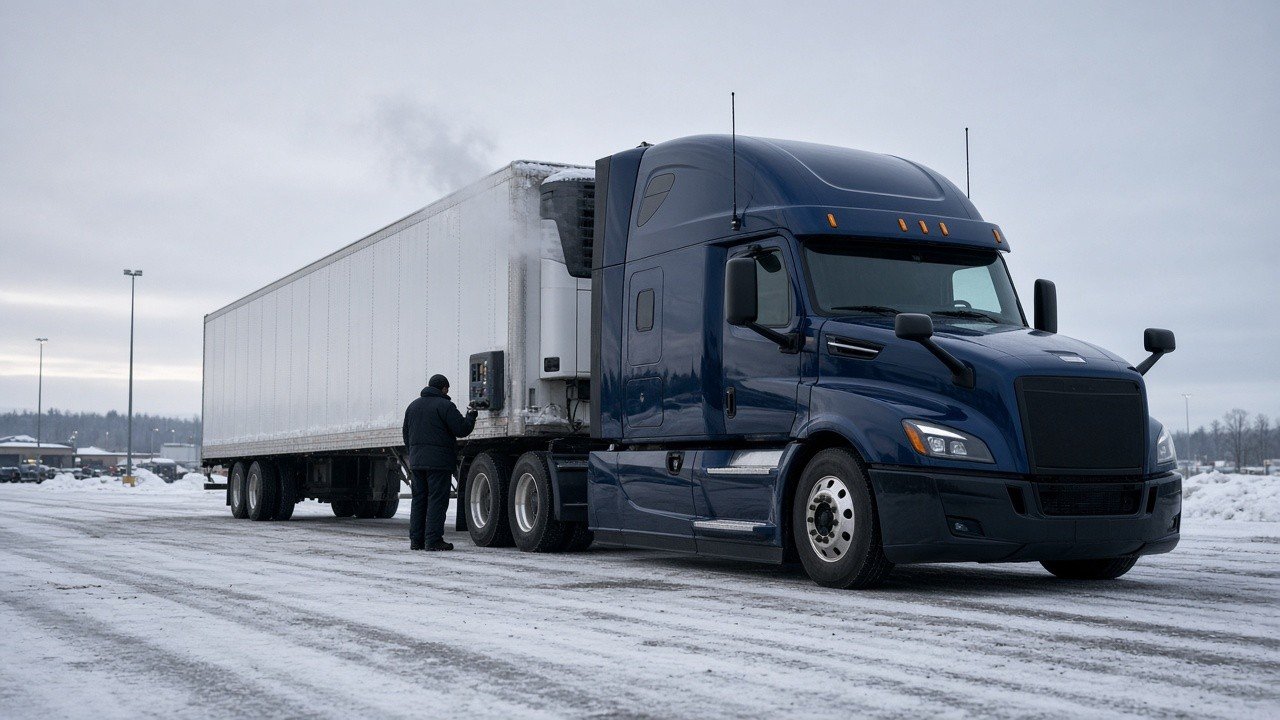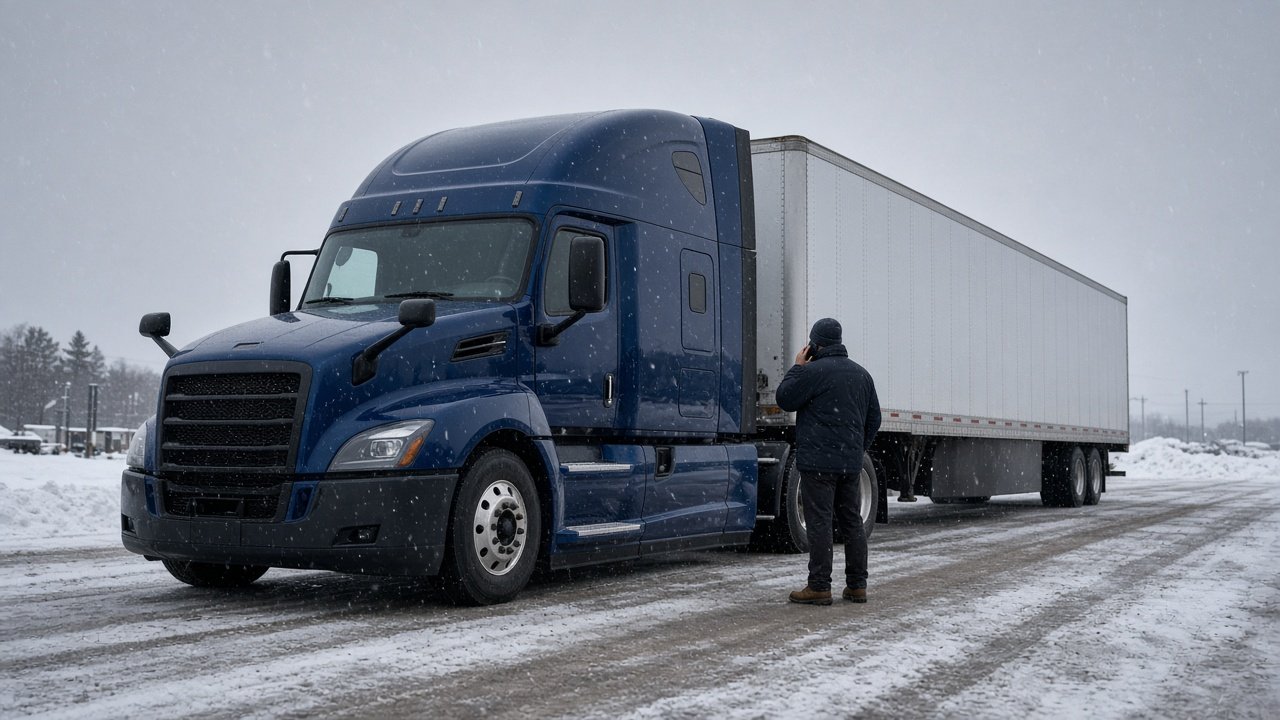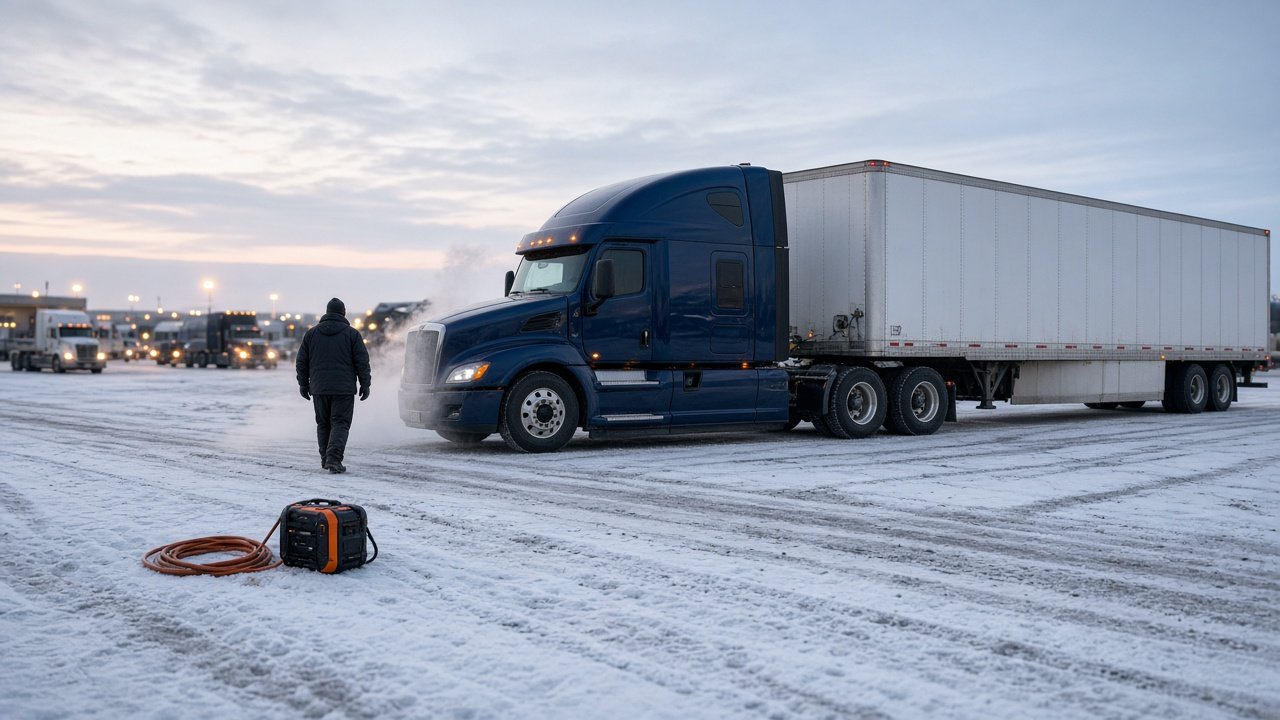
If your semi truck battery is dead in the cold, it is usually not bad luck. Cold weather cuts what a battery can deliver right when a cold diesel needs the most cranking power. Battery University notes that a battery giving 100 percent capacity at 80°F typically delivers only about 50 percent at 0°F (source). Add a night of bunk heater, fridge, inverter and phone chargers, and you can wake up to a truck that just clicks. The fix is mostly prevention: know your overnight load, keep connections clean, test the batteries before the deep cold hits, and carry a safe way to jump-start.
This guide is for working CDL-A drivers heading into the first real cold snaps of November. It covers why trucks die overnight, what to check this week, a worked example of overnight battery use, and how to jump a truck without getting hurt.
Why does a semi truck battery die in the cold?
Three things stack up against you in winter:
- Less capacity. Cold raises a battery's internal resistance and lowers its capacity (Battery University, BU-502). The stored energy is still there, but the battery can't hand it over as fast.
- Harder cranking. Cold engine oil is thicker and a cold diesel needs more cranking before it fires, so the starter pulls more from a weaker battery.
- Bigger overnight loads. Long, dark nights mean more hours with the bunk heater, lights, fridge and electronics running off the batteries with the engine off.
There is also a damage risk. Battery University points out that a lead-acid battery can freeze and crack its case, and that it freezes more easily when its charge is low (source). A run-down battery left in deep cold can be ruined, not just drained.
What should you check on your batteries this week?
Do this at your next 34-hour reset or long break, before the next arctic front, and add the quick items to your cold-weather pre-trip:
- Look at the battery box. The cover should be in place and latched. Federal rules require batteries outside the engine compartment to be covered by a fixed part of the vehicle or a removable cover that is "securely latched or fastened" (49 CFR 393.30, as of November 2026). Clear packed snow and slush away from it.
- Check terminals and cables. White or green crust, loose clamps, or cables that are warm after cranking all point to a bad connection. A corroded terminal can stop a start even when the batteries are charged. Report it so the shop can clean and tighten it.
- Ask for a load test. A voltmeter reading alone can mislead you. Battery University explains that surface charge and the truck's always-on electrical loads distort voltage readings (BU-903). A shop load test or conductance test tells you more. If your truck cranked slowly on the last cold morning, ask for one before the next one.
- Watch your gauge and the dash. Many trucks show system voltage or a low-voltage warning. Note what your truck reads when it's healthy so you can tell when it's not.
- Know your low-voltage disconnect. Some trucks and APUs cut sleeper loads when voltage drops, to save enough for a start. Find out if yours has one and what it powers down.
How much battery do you use overnight in the sleeper?
This is where most winter no-starts start. Here is a simple way to think about it.
Worked example (hypothetical numbers, for illustration only):
- Bunk heater fan and pump: 2 amps
- 12-volt fridge: 4 amps (averaged)
- Inverter running a laptop, TV and phone chargers: 6 amps
- Total: 12 amps for a 10-hour night = 12 × 10 = 120 amp-hours
Now say the batteries together are rated around 400 amp-hours at room temperature (hypothetical). At 0°F, using Battery University's rule of thumb of roughly half the capacity, you may only have about 400 × 0.5 = 200 amp-hours available. Pull 120 of those overnight and you're left with about 80, and you still need a strong burst to crank a cold diesel. That's a coin-flip morning.
Your real numbers will differ. Check the labels on your accessories and ask your shop what your battery bank is rated for. The point is the math: cold cuts what you have, and long nights increase what you use.
How do you keep the truck starting on cold nights?
- Cut the extras. Turn off the inverter when you're not using it. Charge devices while driving, not overnight.
- Use a battery-safe heat source. If you have an APU or a battery-based system with a low-voltage cutoff, know how it works. Check state and local idling rules before you idle for heat, since many places limit it and cold-weather exemptions vary.
- Use engine and block heaters where offered. Some truck stops and terminals have plug-in power. A warm engine cranks easier, which takes load off the batteries.
- Park smart. When you can, park out of the wind and near help. Use our truck parking finder to plan a stop where you could get a jump or a road service call if needed.
- Drive long enough to recharge. Lots of short moves and long idle-off nights can leave batteries under-charged. A solid run gives the alternator time to catch up.
- Keep your fuel side right too. A truck that won't start can also be a fuel problem. See our diesel gelling guide so you can tell the two apart.
How do you jump-start a semi truck safely?
Follow your carrier's procedure and the truck's manual first. Many carriers want you to call road service rather than jump a truck yourself. If you are allowed to jump it, keep these safety points in mind:
- Batteries can give off explosive gas. Workplace battery rules require ventilation "to prevent the accumulation of an explosive mixture" and face shields and gloves for people handling batteries (29 CFR 1926.441). No smoking, no open flame, and protect your eyes.
- Use heavy-duty cables or a jump pack rated for a diesel truck. Light car cables can overheat.
- Match polarity and follow the manual's connection order. Getting positive and negative mixed up can damage the electrical system and the ECM.
- Never jump a frozen battery. If the case is bulging or cracked, or you suspect it froze, don't jump it. Call road service.
- If you're stopped on a shoulder, set out triangles. Federal rules require hazard flashers right away and warning devices within 10 minutes (49 CFR 392.22).
Common mistakes
- Running the inverter all night and assuming the truck will start like it did in October.
- Ignoring a slow crank. A slow start on a cold morning is often an early warning.
- Trusting a quick voltmeter reading instead of getting a real load test.
- Leaving the battery box cover loose or packed with snow and slush.
- Jumping a battery that may be frozen or damaged.
- Having no backup plan. Keep road service numbers, gloves and warm layers in your winter emergency kit.
Frequently asked questions
How cold does it have to be to kill a truck battery?
There's no single number. Capacity drops as it gets colder, to about half at 0°F per Battery University. Older batteries, bad connections and big overnight loads make a no-start more likely at milder temperatures.
Can a dead battery freeze?
Yes. A lead-acid battery with a low charge freezes more easily, and freezing can crack the case (source). Keep batteries charged in deep cold.
Should I idle all night to protect my batteries?
Check the idling rules where you park and your carrier's policy first. Many drivers use an APU, a bunk heater with a low-voltage cutoff, or a plug-in instead.
Who pays if I lose time waiting for road service?
It depends on your carrier's pay policy. Our guide to detention, layover and breakdown pay covers what to ask. If your carrier leaves you stuck in the cold with old equipment, it may be time to look at other CDL-A jobs.
Know a CDL-A driver who's tired of no-starts and old equipment? Refer them to us. It's free for drivers. Refer a driver here.
Free for CDL-A drivers: get our Job Offer Checklist — 23 questions to ask any carrier about pay, miles and home time before you sign. Download the free checklist →
Know a CDL-A driver looking for work? Refer them and earn $500 when they complete 30 days on the road. Refer a driver →
CDL Transportation Group | CDL-A OTR Driver Recruiting