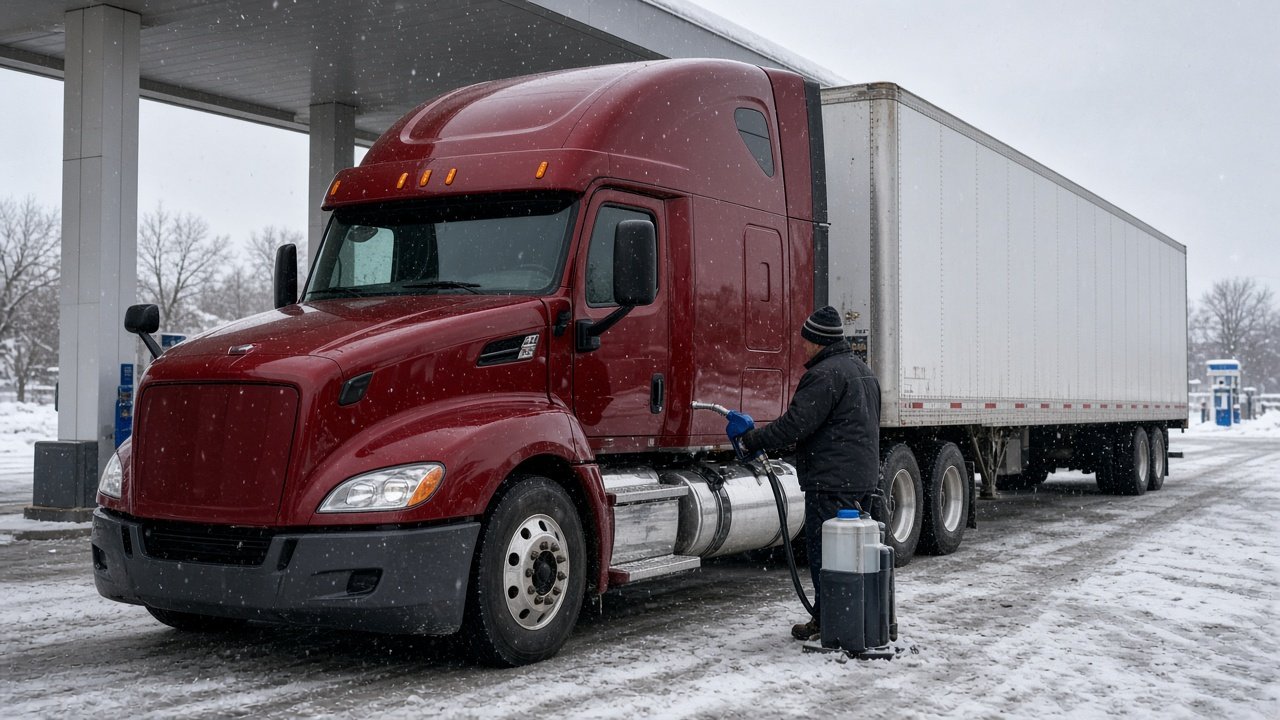
Diesel gelling starts before your fuel turns to jelly. Regular No. 2 diesel begins to form wax crystals at its cloud point, which the U.S. Department of Energy puts anywhere from about -31°F to 23°F depending on the fuel. Untreated fuel can stop flowing just 6°F to 10°F below that. To prevent gelling this winter: buy winterized or No. 1-blended fuel before you head north, treat with anti-gel before the cold hits, drain your water separator, carry spare fuel filters, and never let a cold-soaked truck sit with summer fuel in the tanks.
If you want the general winter driving rundown (black ice, following distance, chains), see our winter driving tips for OTR drivers. This post sticks to one problem: keeping fuel flowing.
At what temperature does diesel gel?
There isn't one number, because every batch of fuel is different. What matters are three temperatures on the fuel itself:
- Cloud point: wax crystals first appear and the fuel looks hazy. Industry guides call this the most conservative warning sign, because those crystals are what coat your fuel filter (CRC low-temperature operability guide).
- Cold filter plugging point (CFPP): the temperature at which the fuel no longer passes a standard test filter. This is where you lose power or stall.
- Pour point (gel point): the fuel is so thick it won't flow at all. In fuel without a pour-point additive, it's roughly 6°F to 10°F below the cloud point.
No. 1 diesel (similar to kerosene) has very little wax, with a cloud point that the Department of Energy lists at about -40°F to -60°F. That's why winter blends mix No. 1 into No. 2.
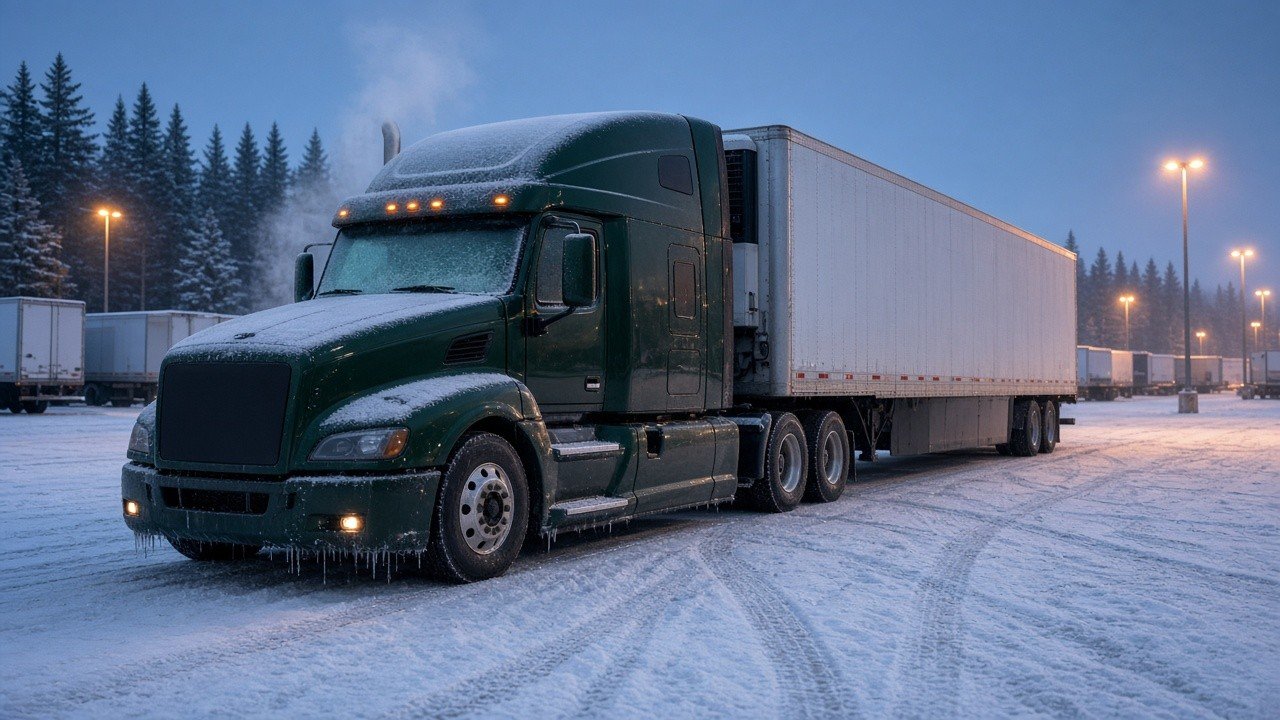
One detail that catches experienced drivers: your fuel lines and filter are small and cool down much faster overnight than the fuel in your tanks. The CRC guide notes fuel can gel in the lines or filter while it's still liquid in the tank. So "the tank looks fine" doesn't mean the problem isn't fuel.
How do I prevent diesel gelling on a winter run?
1. Buy fuel for where you're going, not where you are
Retail diesel is generally blended for local conditions. Fuel bought in a warm southern state can carry a cloud point that's fine there and a problem two days later in North Dakota. When your route drops into cold country, plan your fuel stops so you're topping off with winterized fuel near the cold zone. Use our truck stop finder to plan fuel islands on your route and check current diesel prices so you know what a winter top-off will cost.
2. Treat with anti-gel before the cold, not after
Cold flow additives (anti-gel) change the shape of wax crystals so more of them pass through the filter. According to the Filter Manufacturers Council, they can lower the pour point several degrees and delay filter plugging, but they do not lower the cloud point. Only diluting with No. 1 diesel or kerosene does that. Two practical rules:
- Additives work when they're mixed into fuel that's still warm, above its cloud point. One fuel supplier's guidance is to blend when the fuel is at least 10°F above cloud point. Once wax has formed, a standard anti-gel won't undo it.
- Follow the dose on the bottle. More is not better; engine makers warn that overtreating can cause its own problems.
3. Know what's in the pump
Biodiesel blends usually have a higher cloud point than straight petroleum diesel. Some states set seasonal rules for this. Minnesota, for example, requires at least 20% biodiesel in No. 2 diesel in summer but drops it to 5% from October 1 to March 31 (as of November 2026), and No. 1 diesel is exempt. Read the pump label for blend information, especially at small stations off the interstate.
4. Keep water out
Water in fuel freezes into ice slush that blocks filters just like wax does. Drain your fuel/water separator as your truck's manual directs, and keep tanks topped off overnight so there's less air space for condensation.
5. Use the heat you have
Many trucks have fuel heaters (electric, coolant-to-fuel, or return-fuel heaters). Make sure yours actually works before the season. If you park where shore power is available, plug-in tank, block and filter heaters help. If you idle to keep fuel and cab warm, know that idling rules vary by state and city, and some have cold-weather exceptions. Check before you rely on it, and plan a safe spot with our truck parking map.
Worked example: will my fuel gel tonight? (hypothetical)
This is a hypothetical example with round numbers, not a real fuel test.
You fueled in a warm state, and say that fuel has a cloud point of +15°F. You're shutting down tonight where the forecast low is 0°F.
- Cloud point: +15°F. Wax starts forming at 15°F, so 15 degrees above tonight's low.
- Gel point if untreated: about 15 - 10 = +5°F to 15 - 6 = +9°F.
- Forecast low: 0°F, which is 5 to 9 degrees colder than the estimated gel point.
Result: high risk of a plugged filter or gelled lines by morning. Now say you have 300 gallons of tank capacity with 150 gallons of that warm-state fuel still on board, and you add 150 gallons of winterized fuel. Half your fuel still has the +15°F cloud point. You've helped, but you haven't fixed it. A better plan is to arrive at the cold zone low on fuel, fill up with winterized fuel there, and treat with anti-gel while the fuel is still warm.
What do I do if my diesel gels?
- Stop cranking. Long cranking runs down your batteries and can overheat the starter. Your fuel isn't going to clear by trying again.
- Stay safe and warm. If you're stuck on the road, get the truck as far off the travel lane as you can, set out your warning devices, and call your carrier's breakdown line. Don't let your cab get dangerously cold while you wait.
- Get heat to the fuel system. The fix is warming the fuel, filters and lines above the cloud point. Usually that means a heated shop or a mobile service truck.
- Replace the fuel filters. Once a filter is coated with wax, it's often quicker to change it than to wait for it to clear. That's why you carry spares.
- Use the right product. Regular anti-gel is for prevention. There are separate emergency treatments made to re-liquefy gelled fuel. Follow the label exactly.
Never add gasoline or alcohol to diesel. The Filter Manufacturers Council warns this creates an explosion risk and can damage the injection system. Never use an open flame or torch on tanks, lines or filters.
Common mistakes
- Treating after the fuel is already cloudy. Anti-gel prevents trouble; it doesn't reverse wax that has already formed.
- Assuming anti-gel lowers the cloud point. It doesn't. Only No. 1 diesel or kerosene dilution does.
- Running summer fuel into a cold snap. Topping off in the South before a northbound run is the classic setup for a morning no-start.
- No spare filters on board. A spare filter in the side box can save you hours waiting on road service.
- Ignoring the water separator. Ice blocks filters too, and it's easy to blame wax.
Saving money on fuel matters too. See our guide to fuel cards for truckers. If your carrier makes you pay for winter supplies out of pocket, it may be time to look at CDL-A jobs with better support.
Frequently asked questions
At what temperature does diesel gel?
It depends on the fuel. No. 2 diesel cloud points run about -31°F to 23°F, and untreated fuel can gel roughly 6°F to 10°F below its cloud point. Winterized blends and No. 1 diesel handle much colder temperatures.
Does anti-gel lower the cloud point?
No. Cold flow additives help wax crystals pass through the filter and lower the pour point, but they don't change the cloud point. Only blending in No. 1 diesel or kerosene does.
Can I fix gelled fuel by adding regular anti-gel?
Usually not. Regular anti-gel is for prevention. Gelled fuel needs heat, new filters, and possibly an emergency de-gel product made for that job.
Does No. 1 diesel hurt fuel mileage?
It can, a little. No. 1 diesel is less dense, so it carries somewhat less energy per gallon than No. 2 (fuel industry technical review). Most drivers accept that trade in deep cold.
Know a CDL-A driver who's tired of fighting winter alone? Refer them to us. It's free for drivers. Refer a driver here.
Free for CDL-A drivers: get our Job Offer Checklist — 23 questions to ask any carrier about pay, miles and home time before you sign. Download the free checklist →
Know a CDL-A driver looking for work? Refer them and earn $500 when they complete 30 days on the road. Refer a driver →
CDL Transportation Group | CDL-A OTR Driver Recruiting