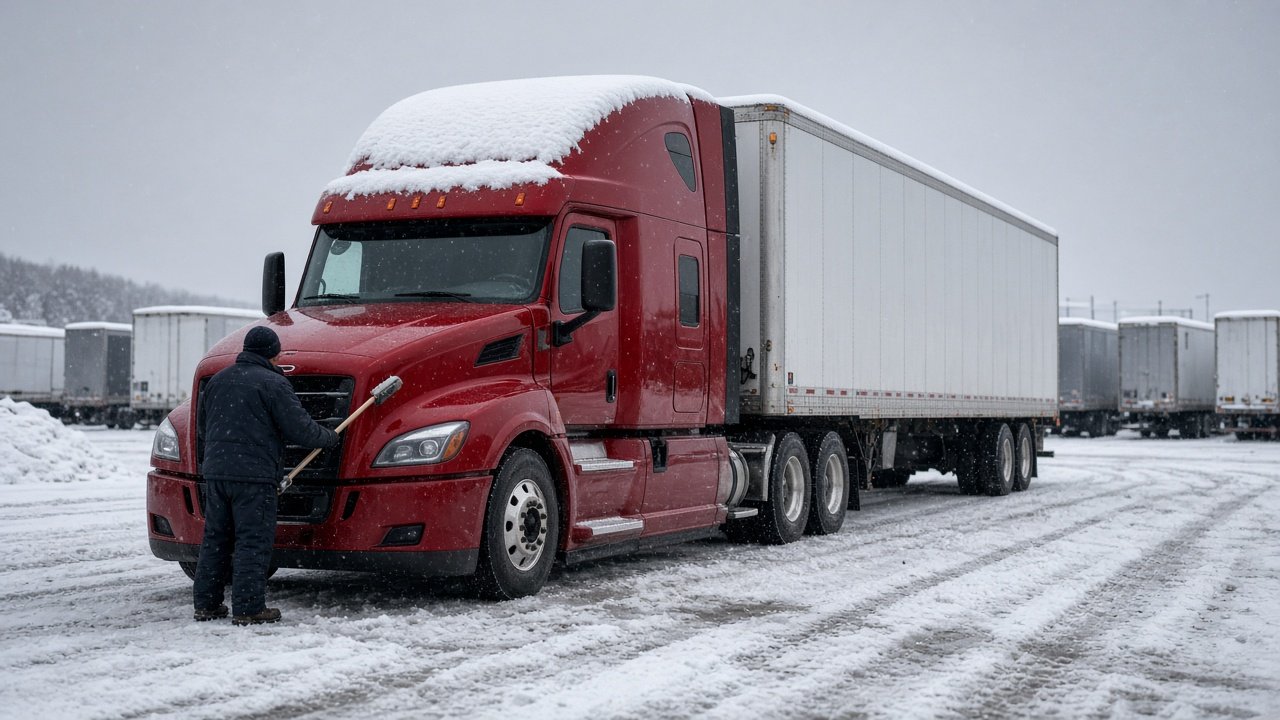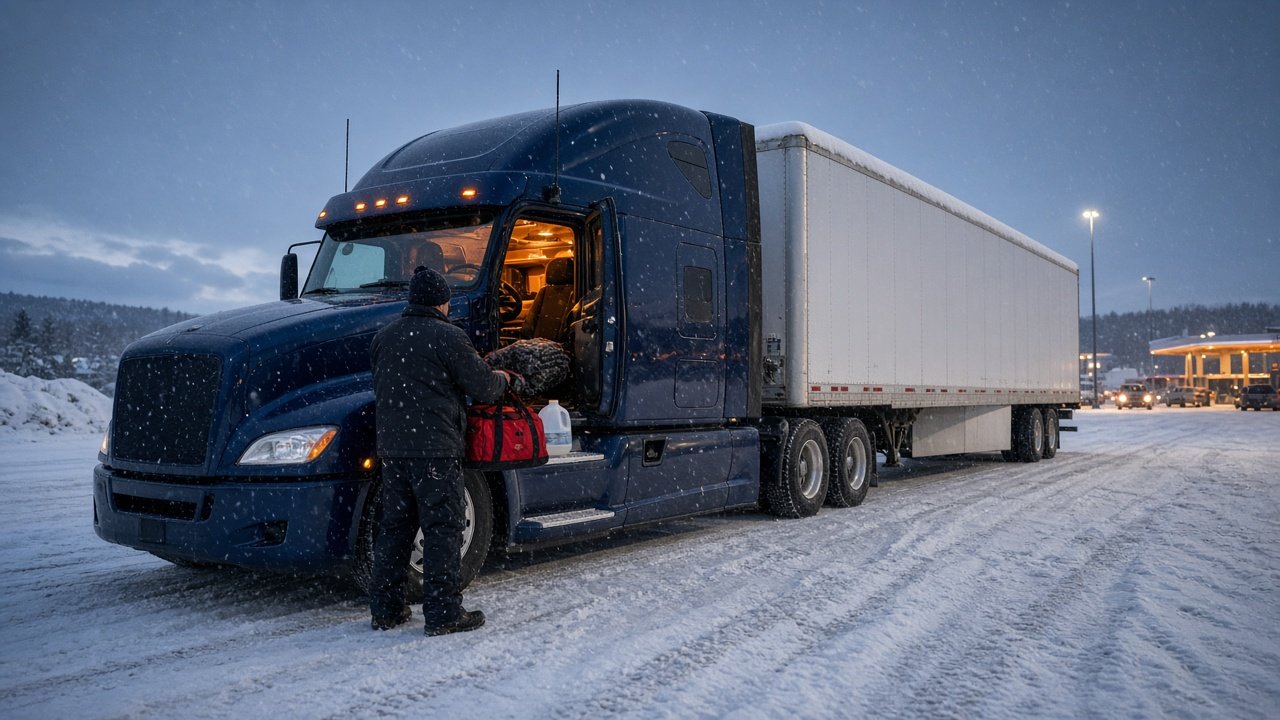
A good winter emergency kit for truckers covers three things: staying warm without the engine, staying fed and hydrated for at least 48 hours, and staying visible and reachable if you're stuck on a closed interstate. In practice that means a winter-rated sleeping bag or heavy blankets, extra layers and dry socks, two days of water and non-perishable food, a headlamp and power bank, a battery-powered carbon monoxide detector, traction aids, and the warning triangles and fire extinguisher federal rules already require. If you get stranded, the rule from the National Weather Service is simple: stay with the vehicle.
November is when the first big storms start shutting down passes and interstates across the northern tier. Build or restock your kit this week, before you're sitting in a mile-long line of stopped trucks wondering how long the diesel and the snacks will last.
What does federal law already require in the truck?
Some of your kit isn't optional. Under 49 CFR 393.95 (as of November 2026), every power unit must carry:
- A fire extinguisher rated at least 5 B:C (or two rated 4 B:C), or 10 B:C if you're hauling placarded hazmat. It must be charged, securely mounted, and use an agent that doesn't need protection from freezing.
- Warning devices: three bidirectional reflective triangles, or at least six fusees (fusees aren't allowed on some hazmat loads).
Winter is when you actually use the triangles. 49 CFR 392.22 says that when you're stopped on the traveled portion or shoulder of a highway, you turn on your four-ways immediately and place the triangles within 10 minutes. Check this week that all three are in the truck, unbroken, and easy to reach, not buried under a load bar behind the seat.
What should a CDL-A driver keep in a winter emergency kit?
Think about the worst realistic case: the road is closed, you can't move for a day or two, and you may not be able to run the truck the whole time. Pack for that.
Warmth (assume the engine and bunk heater could quit)
- A sleeping bag rated well below freezing, or two heavy wool or fleece blankets
- Thermal base layers, an insulated jacket and bibs, a warm hat, a neck gaiter
- Two pairs of insulated gloves (one always ends up wet) and several pairs of wool socks
- Insulated, waterproof boots with real tread for chaining up and walking icy lots
- Chemical hand and foot warmers
Food, water and medicine
- At least two days of drinking water. Keep it inside the cab so it doesn't freeze solid.
- Two days of food that needs no cooking: nuts, jerky, peanut butter, protein bars, canned food with pull tabs
- A few extra days of any prescription medication you take
- A basic first-aid kit
Light, power and communication
- A headlamp plus spare batteries (cold drains batteries fast)
- A charged power bank and a 12-volt phone charger
- A battery-powered carbon monoxide detector in the sleeper
- Optional: a hand-crank or battery NOAA weather radio for when cell service drops
Truck and traction gear
- Your chains (if you run chain-law states), bungees or cams, and heavy gloves for chaining. See our chain laws by state guide.
- A snow brush, ice scraper and small folding shovel
- A bag of sand or kitty litter for traction under the drives
- Extra washer fluid rated for sub-zero temps
- Diesel anti-gel additive and a spare fuel filter. Our diesel gelling guide covers when to use it.
- A bright-colored cloth or flag you can tie to a mirror so rescuers can spot you
What should you do if you get stranded in a winter storm?
The National Weather Service and Ready.gov give the same core advice for anyone stuck in a vehicle, and it applies to a sleeper cab too:
- Stay in the truck. People who walk away from vehicles in wind-driven snow get disoriented quickly. Your cab is shelter.
- Get visible. If you're stopped on the shoulder or in a lane, run your four-ways and set your triangles as required. Tie a bright cloth to a mirror. Keep marker lights on at night if you can spare the power.
- Keep the exhaust clear. Snow piling up around the stacks or a bunk heater exhaust can push carbon monoxide into the cab. Check it every time you run the engine or heater, and crack a window a little for fresh air.
- Manage heat and fuel. If you're low on fuel, run the engine in intervals instead of all night. NWS suggests about 10 minutes an hour for passenger cars. Layer up and use the sleeping bag so you need less heat.
- Tell people where you are. Call or message dispatch with your exact location (mile marker, direction, nearest exit) and check in on a set schedule. Save phone battery between calls.
- Don't overexert yourself. Shoveling heavy snow or fighting chains in a blizzard can bring on a heart attack, and sweat soaks your clothes and leads to chills.
Learn the warning signs, too. Ready.gov lists numbness and white or grayish-yellow, waxy skin for frostbite, and shivering, confusion, fumbling hands, slurred speech or drowsiness for hypothermia. A body temperature below 95°F is an emergency. This is general information. If you or someone with you shows these signs, call 911.
Do hours-of-service rules give you extra time in a storm?
Sometimes. Under the adverse driving conditions exception in 49 CFR 395.1(b), a driver who runs into conditions like snow and ice that weren't known at the start of the run, and who can't safely finish within the normal limits because of them, may drive up to two extra hours to complete the run or reach a safe place. It is not permission to push through a storm. 49 CFR 392.14 says that when snow, ice or sleet make conditions dangerous enough, you stop driving and don't resume until it's safe. Annotate your ELD if you use the exception. Our hours-of-service guide has the basics.
Example: how much water and food should you pack?
Hypothetical example. Say you plan for a 48-hour road closure and want about a gallon of water per day for drinking and a little washing. That's 2 days × 1 gallon = 2 gallons, so two 1-gallon jugs, kept in the cab. For food, if you want roughly three small meals a day, that's 2 days × 3 = 6 no-cook meals, plus snacks. Add one more day of both if you run remote lanes like I-80 in Wyoming or I-90 in Montana where closures can stretch on. It fits in one duffel bag and a milk crate.
Common mistakes
- Keeping water in a side box. It freezes solid overnight. Keep it inside.
- Relying only on the engine or bunk heater. Fuel, batteries and heaters fail in the cold. Your sleeping bag and layers are the backup.
- No CO detector. Carbon monoxide has no smell. A snow-blocked exhaust while you sleep is a real risk.
- Waiting to fuel. Top off before you head into a storm zone. Check diesel prices and plan your stop before the weather hits.
- Not planning parking. When roads close, lots fill fast. Use our truck parking map and truck stop finder to pick a safe place to shut down early.
- Leaving the triangles buried. You have 10 minutes to set them. You won't find them fast under gear in the dark.
Frequently asked questions
Is a winter emergency kit required by law for truckers?
Only parts of it. Federal rules require a fire extinguisher and warning devices on every power unit. Blankets, food, water and the rest aren't required, but they're what keeps you safe during a long closure. Some carriers have their own winter gear requirements, so ask yours.
Should I stay in my truck if the interstate is closed?
Yes, in most cases. The National Weather Service says to stay with your vehicle in a winter storm. Leave only if the truck is in immediate danger, such as a fire, or emergency crews tell you to.
How do I avoid carbon monoxide poisoning in the sleeper?
Keep the exhaust and any bunk heater exhaust clear of snow, crack a window slightly when the engine is running, and use a battery-powered CO detector.
Where can I check road closures before I leave?
Most states have a 511 road conditions website or phone line run by the state DOT. Check it for every state on your route before you roll, along with the forecast.
Know a CDL-A driver heading into winter at the wrong carrier? Refer them to us. It's free for drivers. Refer a driver here.
Free for CDL-A drivers: get our Job Offer Checklist — 23 questions to ask any carrier about pay, miles and home time before you sign. Download the free checklist →
Know a CDL-A driver looking for work? Refer them and earn $500 when they complete 30 days on the road. Refer a driver →
CDL Transportation Group | CDL-A OTR Driver Recruiting