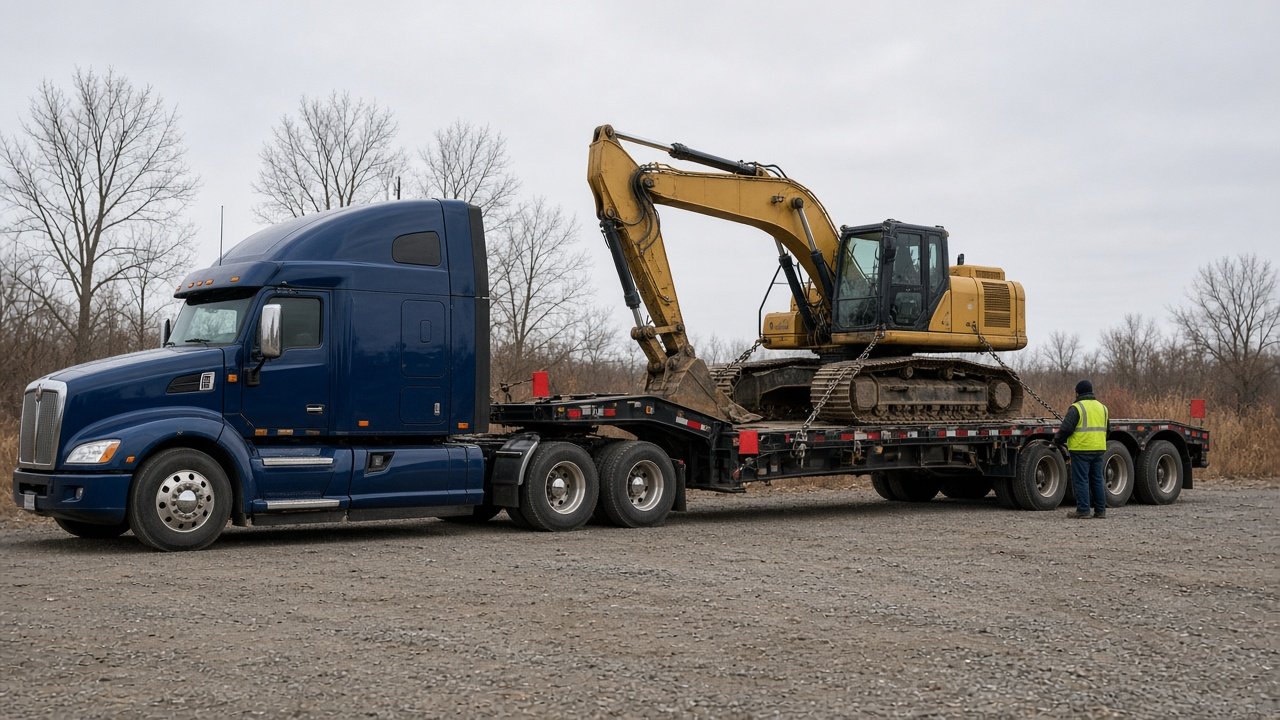
Heavy haul trucking jobs pay CDL-A drivers to move loads that are too big or too heavy for a normal trailer: excavators, dozers, cranes, transformers and other freight that can't be broken down. Most of these loads go on lowboy or removable gooseneck (RGN) trailers and need state oversize/overweight (OS/OW) permits. To do the work, you need solid flatbed securement skills, patience with permits and routing, and a carrier that pays you for the extra time. Here's what the job actually involves as of November 2026, so you can decide if it fits you.
What counts as a heavy haul load?
A load becomes "heavy haul" when it goes over legal size or weight limits. On the National Network, states must allow trailers up to 102 inches (8.5 feet) wide. On the Interstate System, federal limits are 80,000 lbs gross, 20,000 lbs on a single axle and 34,000 lbs on a tandem, and the bridge formula can lower those numbers. There is no federal height limit. FHWA says state height limits range from 13.6 to 14.6 feet.
Go over any of those numbers and you need a permit. The federal government doesn't issue OS/OW permits. Each state does. Permits are mostly for nondivisible loads, meaning freight that can't reasonably be taken apart to get it under the limits.
How do oversize permits and escorts work?
You need a permit from every state on your route. The permit lists the exact dimensions and weight, the approved route and any travel conditions. For example, TxDMV says a vehicle or load over Texas legal limits must have an OS/OW permit, plus an authorized route when one applies, before it moves. You also have to know the exact dimensions and weight before you apply.
Escort (pilot car) rules are set by each state, so they vary. Under Texas rule 43 TAC 219.11 (as of November 2026):
- Loads wider than 12 feet must use the outside lane on multi-lane highways, unless the permit says otherwise.
- Loads wider than 14 feet, up to 16 feet, need one escort. It runs in front on two-lane roads and behind on roads with four or more lanes.
- Loads wider than 16 feet need front and rear escorts. They also stay off controlled-access main lanes unless TxDOT approves an exception.
Other states use different trigger points, so read every permit before you roll. Permits often add travel-time limits, like daylight only or no weekend or holiday moves. With Thanksgiving next week, check your permits now for any holiday curfews.
What securement rules apply to heavy equipment?
Heavy equipment on wheels or tracks that weighs 10,000 lbs or more has its own rule: 49 CFR 393.130. In short:
- Lower accessory equipment, such as buckets, blades and booms, all the way and secure it.
- Restrain articulated machines so they can't bend in transit.
- Restrain the machine against forward, rearward, side-to-side and vertical movement with at least four tiedowns, placed as close as practical to the front and rear or on the maker's designated tie points.
The general working load limit rules in 49 CFR 393.106 also apply. Know how your chains and binders are rated before you hook up. Roadside inspectors check heavy haul loads closely.
Worked example: does this load need a permit?
Hypothetical example, not a real load. You're asked to haul a tracked excavator on an RGN in Texas:
- Width: the machine's tracks are 11 feet wide. That's over 8.5 feet, so you need an overwidth permit. At 11 feet, it's under the Texas 12-foot outside-lane trigger and the 14-foot escort trigger.
- Height: deck height 2 ft + machine height 11 ft 8 in = 13 ft 8 in. That's over a 13.6-foot (13 ft 7.2 in) state limit, so height matters too. Ask the shipper to measure the machine as it will actually be loaded.
- Weight: tractor 20,000 lbs + RGN 22,000 lbs + machine 52,000 lbs = 94,000 lbs. That's 14,000 lbs over 80,000, so you need an overweight permit, and the axle weights have to match what the permit allows.
One load, three permit issues. That's why heavy haul runs slower than van freight, and why your pay plan has to cover the extra time.
How much do heavy haul trucking jobs pay?
There's no reliable public number just for heavy haul drivers. The BLS puts the median pay for all heavy and tractor-trailer truck drivers at $58,640 a year (May 2025). Heavy haul pay depends on the carrier, the freight and the pay plan. Common plans are a percentage of the load, a rate per mile or a day rate. When you compare offers, ask about:
- Pay for loading, chaining and unloading time
- Pay while you wait on permits, escorts or curfews (see our guide to TONU and canceled-load pay)
- Layover pay when a permit holds you over a weekend or holiday
- Who pays for and checks permits, routes and escorts
- Home time, because projects can send you far from home
To see how heavy haul compares with other freight, read dry van vs reefer vs flatbed vs tanker pay. If energy-sector work interests you, see oilfield trucking jobs.
What experience do carriers want?
Most heavy haul carriers want CDL-A drivers with real flatbed or step-deck time, a clean MVR and inspection history, and proof that you can chain down equipment correctly. Many also want lowboy or RGN experience. If you haven't run oversize before, look for a flatbed or step-deck job that hauls some equipment first. Browse current CDL-A jobs or use our driver match tool to find openings that fit your experience.
Common mistakes
- Trusting the paperwork. Measure the loaded height and width yourself. A few inches off can break a permit or hit a bridge.
- Leaving the permitted route. Detours, wrong exits and fuel stops off the route can leave you running without a valid permit.
- Skipping the curfew check. Moving outside your permitted hours, or on a restricted holiday, can get you fined and put out of service.
- Weak securement. Too few tiedowns, a raised bucket or blade, or chains with no visible rating are easy violations.
- Not planning parking. Oversize rigs can't fit just anywhere. Plan stops with our truck parking and truck stop tools, and check diesel prices along the approved route.
Frequently asked questions
Do I need a special endorsement for heavy haul?
No federal CDL endorsement exists for oversize or overweight freight. A CDL-A covers the tractor-trailer. Some states certify escort drivers, and carriers set their own experience rules.
Who gets the oversize permit, the driver or the carrier?
The carrier or a permit service usually orders it. You're still the one responsible for following it on the road, so read it before every move.
Is a lowboy the same as an RGN?
An RGN is a type of lowboy with a gooseneck that comes off, so equipment can drive onto the deck from the front. Fixed-neck lowboys and step-decks are also common in heavy haul.
Can I run heavy haul at night?
It depends on the state and the permit. Many oversize permits limit travel to certain hours, so check each permit's conditions.
Know a CDL-A driver who's ready for heavier freight? Refer them to us and earn $500. Refer a driver here.
Free for CDL-A drivers: get our Job Offer Checklist — 23 questions to ask any carrier about pay, miles and home time before you sign. Download the free checklist →
Know a CDL-A driver looking for work? Refer them and earn $500 when they complete 30 days on the road. Refer a driver →
CDL Transportation Group | CDL-A OTR Driver Recruiting