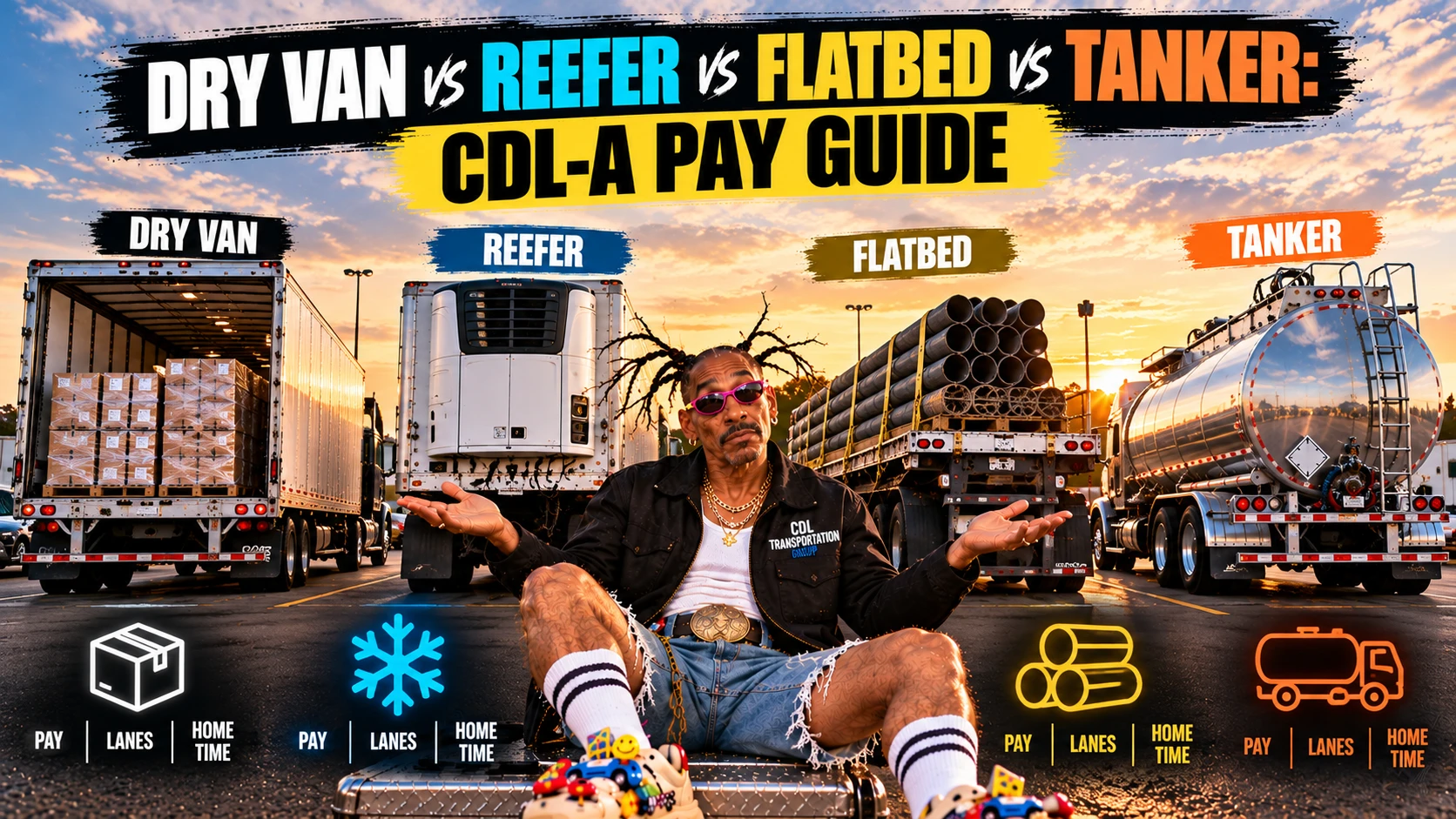
In posted CDL-A jobs, reefer has a higher weekly median than dry van (about $1,600 vs $1,500), flatbed a lower one (about $1,350), and hazmat tanker work sits near the top of the range, but the right fit depends on how much physical work, paperwork and home time you will trade for the money. If you already hold a CDL-A and are choosing between dry van, reefer, flatbed and tanker, this guide compares them side by side. Figures are as of October 2026.
How much does each CDL-A trailer type pay?
Job-posting data from Lanefinder (updated July 2026) gives these weekly pay medians for posted CDL-A jobs:
- Dry van: about $1,500 a week, with the middle half of postings between roughly $1,200 and $1,850.
- Reefer: about $1,600 a week, with the middle half between roughly $1,300 and $2,000. See Lanefinder's reefer page.
- Flatbed: about $1,350 a week, with the middle half between roughly $1,100 and $1,750. See the flatbed page.
- Tanker: we could not confirm a single median. Lanefinder's data places hazmat tanker work near the top of the pay range.
These are medians of what carriers advertise, not what drivers are guaranteed to earn. Advertised weekly pay often assumes a certain number of miles, and a flatbed driver with a lower weekly figure may be paid a higher rate per mile but run fewer miles because of tarping and securement time. Treat the numbers as a starting point and read the offer itself (see How to Read a CDL-A Job Offer).
What is dry van hauling like?
Dry van is the most common CDL-A job. You pull an enclosed box trailer of palletized or boxed freight, and a lot of it is no-touch freight, meaning you do not load or unload. Pros: the most openings, easy to find a lane that fits your home time, and the least physical work. Cons: more competition for loads, so pay per mile tends to be flat, and live loading or unloading at some docks can mean long waits (see Detention, Layover and Breakdown Pay).
Is reefer worth the extra pay?
Reefer pulls a refrigerated trailer for food, produce and pharmaceuticals. The posted median above is a bit higher than dry van. The trade-offs are real:
- Tight delivery appointments, because the product is perishable.
- You are responsible for the reefer unit: setting temperature, checking fuel and monitoring alarms.
- Reefer fuel is a separate tank, and the unit often runs through your sleep, so the noise is part of the job.
- Food-related loads can mean more paperwork and more waiting at receivers.
If you do not mind schedule pressure, reefer is a common step up from dry van without a big change in how you work.
What does flatbed involve?
Flatbed hauls steel, lumber, machinery and building materials on an open deck. You strap, chain and tarp your own load, which is physical, weather-dependent work. Pay per mile is often higher to compensate, but the median weekly figure above sits below dry van and reefer, partly because securement and loading take time and miles. Flatbed drivers also need to know cargo securement rules well; see the FMCSA's cargo securement rules. Flatbed is a good fit if you want variety and do not mind working outdoors in every season.
Do you need an endorsement for tanker?
Yes. Under 49 CFR 383.93, a tank vehicle endorsement (N) requires a knowledge test, and a hazardous materials endorsement (H) also requires a knowledge test. Drivers who want both get an X endorsement. Federal rules also require a TSA security threat assessment before a state may issue an H endorsement, and hazmat endorsements must be renewed at least every five years. Tanker work pays well for a reason: liquid surge changes how the truck brakes and handles, and rollovers are a real risk. Plan on smoother, slower driving and strict load discipline. Check your state licensing agency for test and fee details.
A hypothetical comparison
This is a made-up example to show the math, not a prediction. Say two offers both promise 2,500 miles a week.
- Dry van at $0.58 per mile: 2,500 x $0.58 = $1,450.
- Flatbed at $0.66 per mile, but you only run 2,000 miles after tarping and loading time: 2,000 x $0.66 = $1,320.
The higher rate per mile paid less in the week because of fewer miles. Always ask how many miles drivers on that fleet typically run, not just the rate.
Common mistakes when choosing a trailer type
- Choosing on pay per mile alone and ignoring how many miles you will actually run.
- Underestimating physical work on flatbed, especially in winter.
- Ignoring appointment pressure on reefer until you are in it.
- Taking tanker or hazmat work before you have the endorsement lined up and paid for.
- Not asking about unpaid time such as tarping, loading, waiting or inspections.
How do you decide?
Start with what you want from the job: home time, physical work, schedule predictability and pay. Then compare lanes, not just equipment. An OTR dry van job and a regional flatbed job can feel completely different (see OTR vs Regional CDL-A Jobs). Browse current openings on our jobs page, try the job match quiz, and plan your fuel with the diesel price tracker. Check parking along your lanes at truck parking and truck stops. More tools for drivers are at /drivers.
Frequently asked questions
Does reefer always pay more than dry van?
Not always. The July 2026 posting medians show reefer higher, but individual carriers and lanes vary a lot.
Is flatbed harder than dry van?
Physically, yes. You secure and tarp your own loads and work in all weather.
Can I switch trailer types without a new license?
Dry van, reefer and flatbed need no extra endorsement. Tanker needs an N endorsement and hazmat needs an H endorsement.
Do I have to take a new test for a tank endorsement?
Yes, a knowledge test, as required by 49 CFR 383.93.
This is general information, not career or financial advice. Ask a qualified professional about your situation.
Photo: inkknife_2000, CC BY-SA 2.0, via Wikimedia Commons.
Free for CDL-A drivers: get our Job Offer Checklist — 23 questions to ask any carrier about pay, miles and home time before you sign. Download the free checklist →
Know a CDL-A driver looking for work? Refer them and earn $500 when they complete 30 days on the road. Refer a driver →
CDL Transportation Group | CDL-A OTR Driver Recruiting