Hazmat trucking jobs are CDL-A jobs hauling placarded loads such as fuel, chemicals, compressed gases and other regulated freight. To get hired you need the H endorsement (or X if you also hold tanker), which means a TSA security threat assessment and a knowledge test, and most carriers also want recent tractor-trailer experience and a clean record. Once you're on the job, you work under extra federal rules for shipping papers, parking, attendance, fueling and smoking. The work often pays more than general dry van freight, but the premium depends on the carrier, the lane and the product, so compare offers line by line.
Searches for "hazmat trucking jobs" and "hazmat owner operator jobs" have been climbing on Google this month. This guide is for drivers who already hold a CDL-A and want to know what these jobs really involve before applying.
What kinds of hazmat trucking jobs are there?
"Hazmat" covers very different work. The most common types for CDL-A drivers:
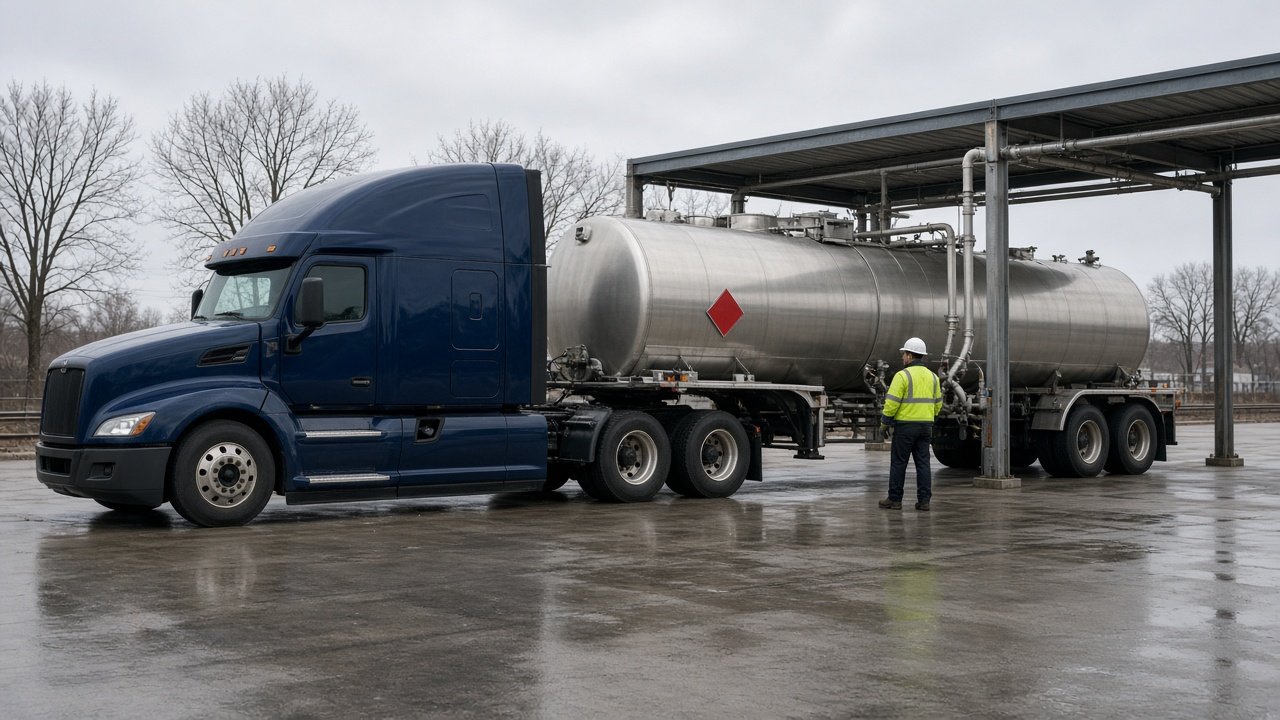
- Fuel tanker: gasoline and diesel from terminals to stations. Usually local or regional, often with several drops per shift, and it needs X (tanker plus hazmat).
- Chemical tanker: bulk chemicals between plants. Often regional or OTR, with more loading and unloading work, hoses and safety gear.
- Compressed gas: propane, industrial gases and similar loads in pressure tanks, with heavy seasonal demand for propane in winter.
- Placarded dry van and LTL: packaged hazmat in a regular trailer. You need H but not N, and the freight looks like any other van load until you read the shipping papers.
- Explosives and high-security loads: Division 1.1, 1.2 and 1.3 materials have the strictest attendance and parking rules and usually go to drivers with years of clean hazmat history.
If you're weighing tanker against other trailer types, our dry van vs reefer vs flatbed vs tanker pay guide lays out the trade-offs.
What do you need to get hired for hazmat jobs?
The license part is covered step by step in our guide to adding hazmat, tanker and doubles endorsements. In short, a first-time H endorsement needs hazmat theory training from a provider on FMCSA's Training Provider Registry, a TSA security threat assessment ($88.25 for new and renewing applicants as of November 2026) and the state knowledge test. Plan on two months.
The endorsement alone rarely gets you the job, so check postings on our CDL-A jobs board or get matched with carriers that fit your endorsements. Carriers and their insurers usually look at:
- Experience: many hazmat and tanker jobs ask for one to two years or more of recent CDL-A time. Requirements vary by carrier and insurer.
- Your record: recent moving violations, preventable accidents and inspection history matter more here than on general freight.
- Clearinghouse and medical card: a clean Drug and Alcohol Clearinghouse record and a current DOT medical card.
- Carrier training: under 49 CFR 172.704, the carrier must give you hazmat employee training. A new hazmat employee can work under direct supervision while finishing it, but it must be done within 90 days, and it repeats at least once every three years.
How much do hazmat trucking jobs pay?
There's no official federal pay figure just for hazmat drivers. The Bureau of Labor Statistics reports a median annual wage of $58,640 for all heavy and tractor-trailer drivers as of May 2025, and hazmat work is part of that group. Hazmat and tanker jobs often pay above general freight because fewer drivers qualify and the work carries more risk, but nobody can promise a set premium. Check how the pay is built: some carriers add a per-mile or per-load hazmat bonus, others pay hourly or by the load for local tanker work, and some just set a higher base rate. Ask about pay for loading, unloading, washouts, waiting at terminals and tank cleaning, because that is where hazmat jobs often differ most.
What rules change your day on a hazmat load?
These are the federal rules you feel most on the road, as of November 2026 (always follow your carrier's procedures and state or local rules too):
- Shipping papers: under 49 CFR 177.817, hazmat papers must be tabbed or on top of your other papers. At the wheel, keep them within reach while you're belted in, either visible or in the holder on the driver's door. When you leave the cab, put them in the door pouch or on the driver's seat.
- Attendance and parking: under 49 CFR Part 397, loads of Division 1.1, 1.2 or 1.3 explosives must be attended at all times, with limited exceptions. They can't be parked within 5 feet of the traveled roadway, and with only short exceptions, not within 300 feet of a bridge, tunnel, home or place where people gather. Other placarded loads have their own attendance and parking limits in Part 397, so know which rules apply to what you're carrying.
- Fueling: the engine must be off, and someone must control the fueling at the fill point (49 CFR 397.15).
- Smoking and fire: no smoking within 25 feet of vehicles carrying explosives, oxidizers or flammables, including empty tanks that last held flammable liquids or gases. Don't park within 300 feet of an open fire (49 CFR 397.11 and 397.13).
- Tires: check every tire at the start of each trip and every time you park (49 CFR 397.17).
Parking is the real day-to-day squeeze. Many lots don't fit hazmat rules or don't allow hazmat at all, so plan stops ahead with our truck parking map and truck stop finder.
Can owner-operators haul hazmat?
Yes, but costs jump. Under 49 CFR 387.9, for-hire carriers hauling most hazmat must carry at least $1,000,000 in public liability coverage, compared with $750,000 for non-hazmat freight. Certain bulk loads, including hazardous substances in cargo tanks, need $5,000,000. That is why many owner-operators get into hazmat by leasing on to a carrier that already holds the coverage and safety programs. If you go that route, read the contract closely; our guide to owner-operator lease agreements covers what to check.
Worked example: comparing two hazmat offers (hypothetical)
This is a hypothetical example with made-up numbers, not a pay quote.
A driver with X on their license gets two offers for regional work averaging 2,200 paid miles a week:
- Offer A: $0.62 per mile plus a $0.05 per-mile hazmat bonus. 2,200 x $0.67 = $1,474 a week. Unloading isn't paid.
- Offer B: $0.60 per mile with no hazmat bonus, but $30 per unload, and the driver averages 6 unloads a week. 2,200 x $0.60 = $1,320, plus 6 x $30 = $180, for $1,500 a week.
Offer A looks better on the per-mile rate, but Offer B pays $26 more each week, about $1,350 a year over 52 weeks, once unloading pay is counted. Ask each carrier for its typical weekly unloads and miles in writing before you compare.
Common mistakes when going after hazmat jobs
- Getting H but not N. Many of the steadiest hazmat jobs are tanker jobs, which need X. Tanker is a knowledge test only, so add both at once.
- Applying before the TSA check clears. The state adds H only after TSA notifies it, and that can take weeks.
- Treating it like a van job. Ignoring parking, attendance or shipping-paper rules can mean violations at a roadside inspection and lost hazmat work.
- Comparing only cents per mile. Loading, unloading, wait time and washout pay can change the weekly total more than the base rate.
- Letting the endorsement lapse. Hazmat has to be renewed at least every five years with a new TSA check, and some states retest you.
Frequently asked questions
Do I need tanker to get a hazmat job?
Not for packaged hazmat in a van, but fuel, chemical and gas tanker jobs need N as well as H, which shows up as X on your license.
Can I get a hazmat job with no hazmat experience?
Some carriers hire experienced CDL-A drivers who are new to hazmat and train them, while others want hazmat history. Your overall CDL-A experience and clean record matter most.
Does hazmat change my hours of service?
The federal HOS limits are the same for hazmat and general freight, but the attendance and parking rules affect where and how you take breaks. See our hours of service guide.
How long does the hazmat endorsement last?
Federal rules require renewal at least every five years with a new TSA security threat assessment. Your state may set a shorter cycle.
Know a CDL-A driver with a hazmat endorsement who's ready for a better job? Refer them to us and earn $500. Refer a driver here.
Free for CDL-A drivers: get our Job Offer Checklist — 23 questions to ask any carrier about pay, miles and home time before you sign. Download the free checklist →
Know a CDL-A driver looking for work? Refer them and earn $500 when they complete 30 days on the road. Refer a driver →
CDL Transportation Group | CDL-A OTR Driver Recruiting