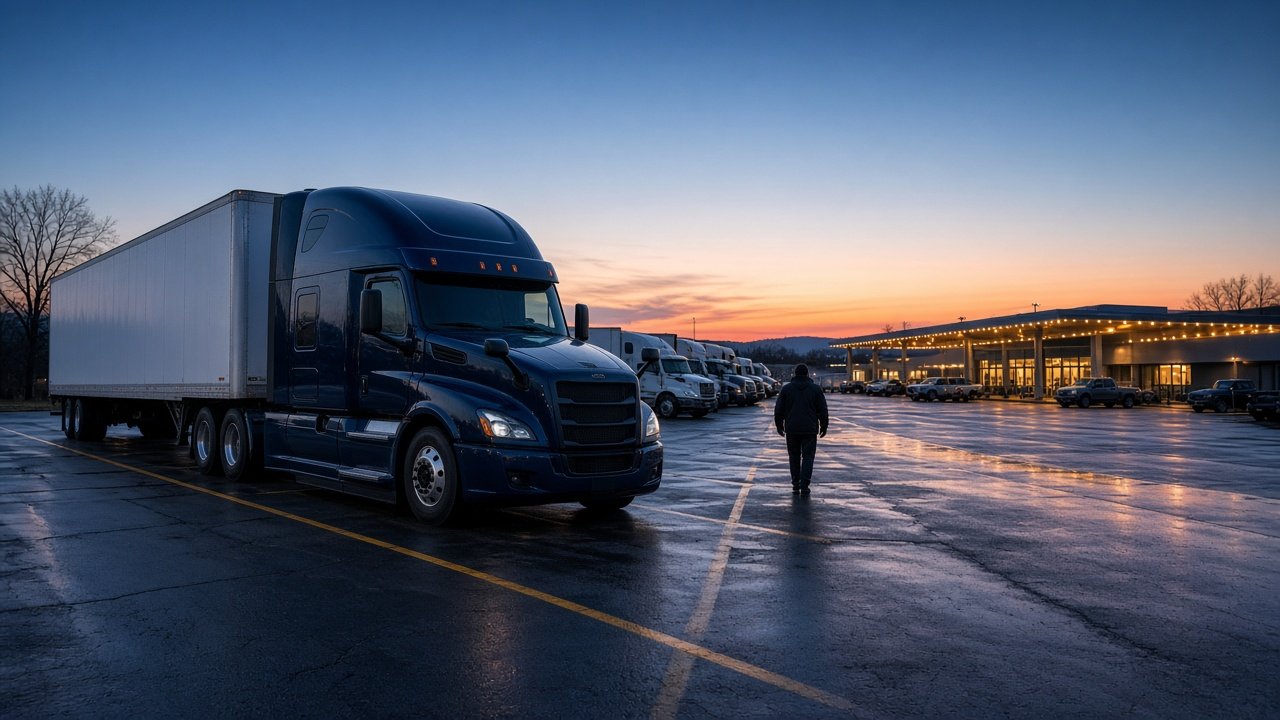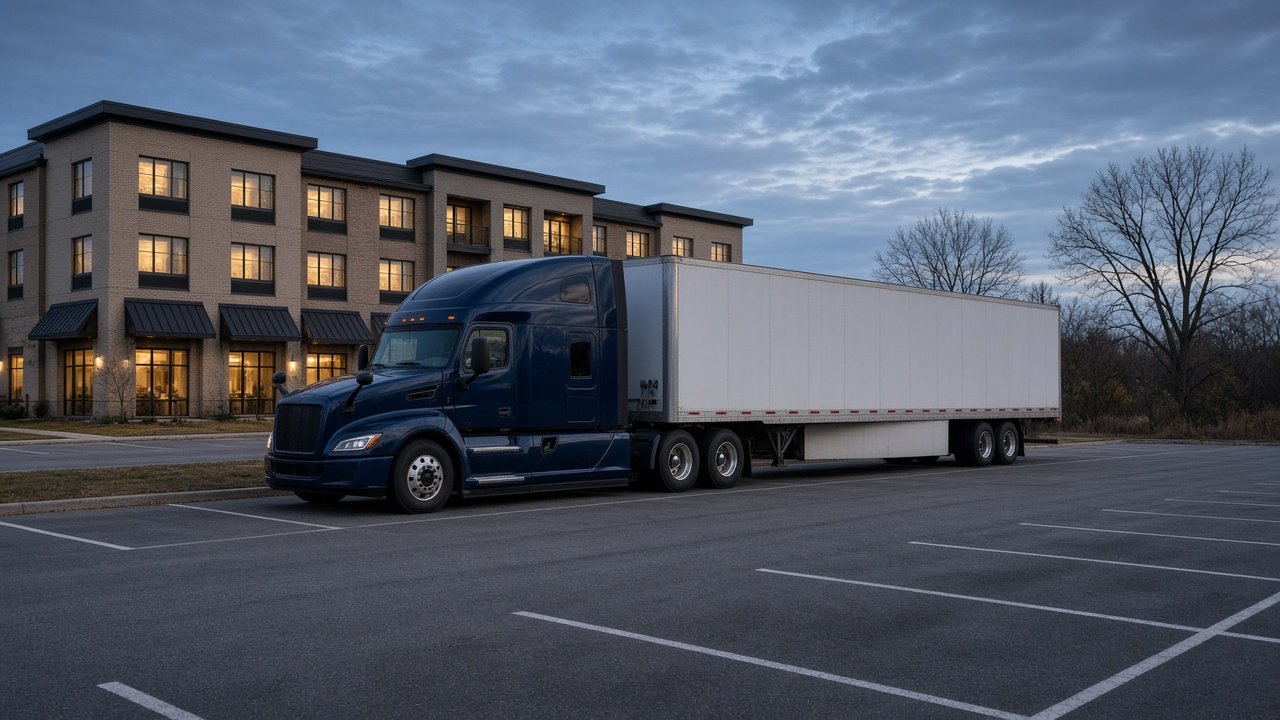
Hotels with truck parking do exist, but most hotels don't allow a tractor-trailer, and very few advertise it. The fastest way to find one is to search truck parking maps for lodging near truck stops and industrial exits, then call the front desk and ask three things: can a 70-foot rig park overnight, where exactly, and is there a fee? Searches for "hotel near me with truck parking" have been climbing on Google Trends this month, and it makes sense: shop delays, 34-hour restarts, weather holds and holiday freight all leave CDL-A drivers needing a real bed. Here's how to find one, what to confirm before you book, and the hours-of-service and hazmat rules that still apply when you sleep off the truck.
Why is it so hard to find a hotel near me with truck parking?
Most hotel lots are built for cars: tight turns, low canopies, curbs and short stalls. Many properties also ban trucks to protect the pavement and keep spots open for guests. On top of that, truck parking is short everywhere. The 2019 Jason's Law survey counted about 313,000 truck parking spaces nationwide, roughly 40,000 at public rest areas and 273,000 at private truck stops (FHWA Jason's Law results). When truck stops fill up, hotel lots are one of the few other options, so it pays to know which ones say yes.
Where do hotels with truck parking usually sit?
- Truck stop exits. Hotels next to or across from a big travel center are the most likely to have a back lot or overflow area for trucks.
- Industrial and distribution areas. Properties near warehouses, ports and rail yards often see truck guests and set aside space.
- Older roadside motels on US highways. Many have wide gravel or paved side lots that fit a rig.
- Hotels with "bus and truck parking." Ask if those spots take a tractor-trailer.
- Hotels near truck repair shops. If you're waiting on a repair, a hotel near the shop may allow bobtail parking while your truck is in the bay.
Use our truck parking map and truck stop finder to see what's near your stop, then look for hotels within walking distance of a lot that takes trucks.
What should you ask before you book?
Booking sites rarely show truck rules. Call the front desk directly and ask:
- Can a tractor with a 53-foot trailer park overnight, or bobtail only?
- Where exactly do I park, and can I get in and back out without backing blind?
- Is there a parking fee, a limit on nights, or a rule against idling or reefers running?
- Is the lot lit, fenced or on camera?
- Get the name of the person who said yes, and ask them to note it on your reservation.
Also check local rules. Some cities ban truck parking on streets and in commercial lots outside designated areas, and a hotel's okay doesn't override a posted no-truck sign or a city ordinance.
Does a hotel stay count for your 10-hour break or 34-hour restart?
Yes, time in a hotel can be logged as off duty, as long as you are relieved of all work and responsibility. Remember that "sleeper berth" means the berth in the truck, so hotel time is off duty, not sleeper berth time. That matters if you were planning a split. A 10-hour break in a hotel works fine as off duty, but it won't pair with a short sleeper period under the split rules. See our guides to the 34-hour restart and split sleeper berth for the details.
Can you use personal conveyance to drive to the hotel?
Often, yes. The FMCSA personal conveyance guidance lists "time spent traveling to a nearby, reasonable, safe location to obtain required rest after loading or unloading" and driving from en route lodging, "such as a motel or truck stop," to restaurants as examples of personal conveyance. It also says some moves don't count: bypassing open rest spots to get closer to your next load, driving the truck to a shop for maintenance, or driving to rest after being placed out of service for an HOS violation (unless an officer tells you to). Your carrier also has to allow PC, so check its policy first.
Can you leave a loaded trailer at a hotel?
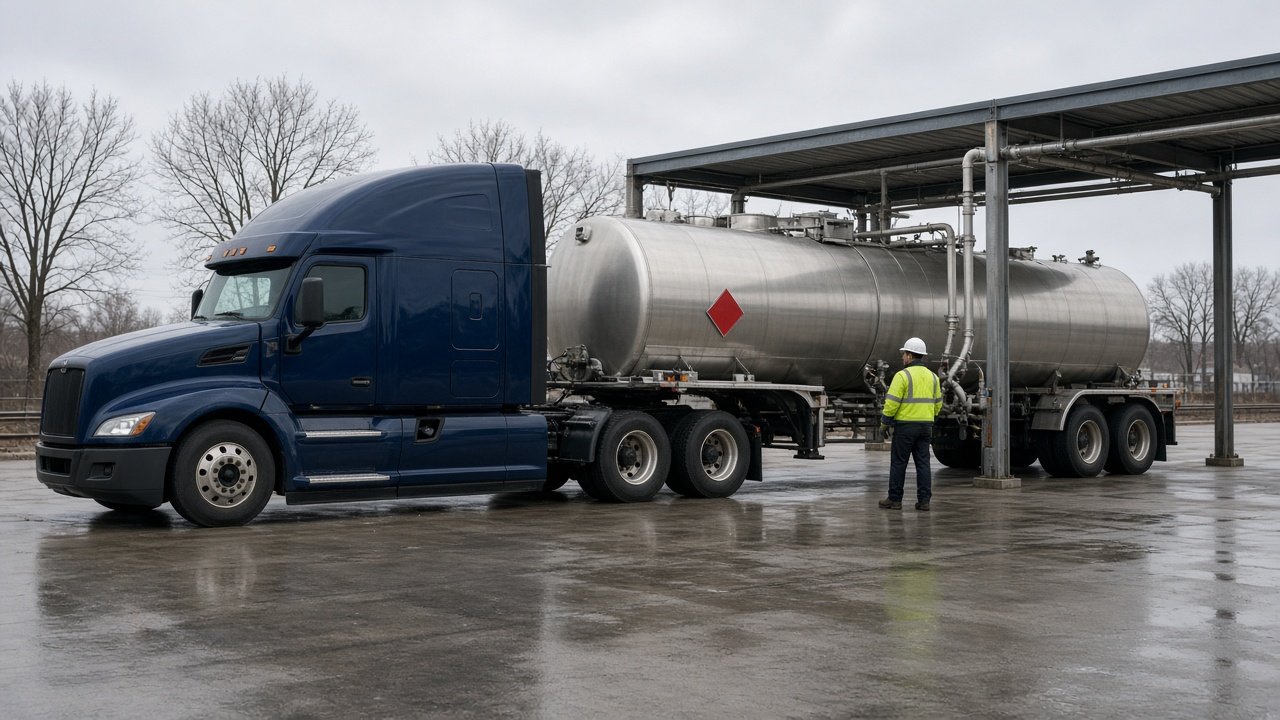
It depends on what's in the box. For hazmat, the rules are strict. Under 49 CFR 397.5, a truck carrying Division 1.1, 1.2 or 1.3 explosives must be attended at all times unless it's on carrier, shipper or consignee property or in an approved safe haven. A truck with other hazmat that is on a public street, highway or shoulder must be attended by the driver. "Attended" means you are on the truck awake and not in the sleeper, or within 100 feet with the truck in plain view. That rules out a night in a hotel room for many hazmat loads, and 49 CFR 397.7 adds parking limits on top. For high-value freight, many carriers forbid leaving a loaded trailer at a hotel at all. Ask dispatch before you drop the hotel idea on a loaded run.
Who pays for the hotel?
No federal rule makes a carrier pay for your hotel. It comes down to company policy. Many carriers cover a hotel when the truck is in the shop overnight or when they keep you waiting on a load. Some cover a hotel during a forced layover, and few cover one for a restart you chose. Get the policy in writing when you hire on, and ask whether they book the room or you pay and get reimbursed. Our posts on detention, layover and breakdown pay and what to do when your truck breaks down cover the rest. If you pay for lodging yourself, keep every receipt; how it's treated on your taxes depends on your situation. This is general information, so ask a qualified tax professional about your situation.
Worked example: two nights while the truck is in the shop (hypothetical)
Say your truck goes into a shop on a Tuesday night and the part won't arrive until Thursday morning. The shop is near a hotel that allows bobtail parking, and your carrier's written policy pays up to $100 per night for breakdown lodging, reimbursed with a receipt.
- Room: $95 per night x 2 nights = $190
- Hotel tax at a hypothetical 12%: $190 x 0.12 = $22.80
- Total: $212.80
- Carrier covers: up to $100 x 2 = $200
- Your cost: $212.80 - $200 = $12.80
Without that policy in writing, the whole $212.80 could be yours. The numbers are examples only; real room rates, taxes and carrier policies vary.
Common mistakes
- Trusting the booking site's parking icon. It almost always means cars. Call first.
- Pulling in without a way out. Check the lot on a satellite map before you commit, and don't plan on backing out past parked cars at night.
- Leaving a hazmat or high-value load unattended. Know the attendance rules and your carrier's policy before you take the room.
- Logging the hotel night as sleeper berth. It's off duty. Log it correctly so your split and your record stay clean.
- Assuming the carrier will pay. Ask before you check in, and keep the receipt either way.
Frequently asked questions
How do I find a hotel with truck parking near me?
Start on a truck parking map, look for hotels near truck stops and industrial exits, and call the front desk to confirm a rig can park overnight and where.
Do hotels charge for truck parking?
Some do and some don't. Ask about a fee, a night limit and idling rules when you call, and get the answer noted on your reservation.
Is hotel time off duty or sleeper berth?
Off duty. Sleeper berth time has to be spent in the truck's sleeper berth.
Can I bobtail to a hotel after dropping my trailer?
Often, if it's a short trip to rest and your carrier allows personal conveyance. Read the FMCSA personal conveyance guidance and your company's PC policy first.
If your carrier won't cover a hotel when the truck is down, browse current CDL-A jobs or get matched with a carrier whose policies fit how you run.
Know a CDL-A driver who's tired of hunting for a place to sleep? Refer them to us and earn $500. Refer a driver here.
Free for CDL-A drivers: get our Job Offer Checklist — 23 questions to ask any carrier about pay, miles and home time before you sign. Download the free checklist →
Know a CDL-A driver looking for work? Refer them and earn $500 when they complete 30 days on the road. Refer a driver →
CDL Transportation Group | CDL-A OTR Driver Recruiting