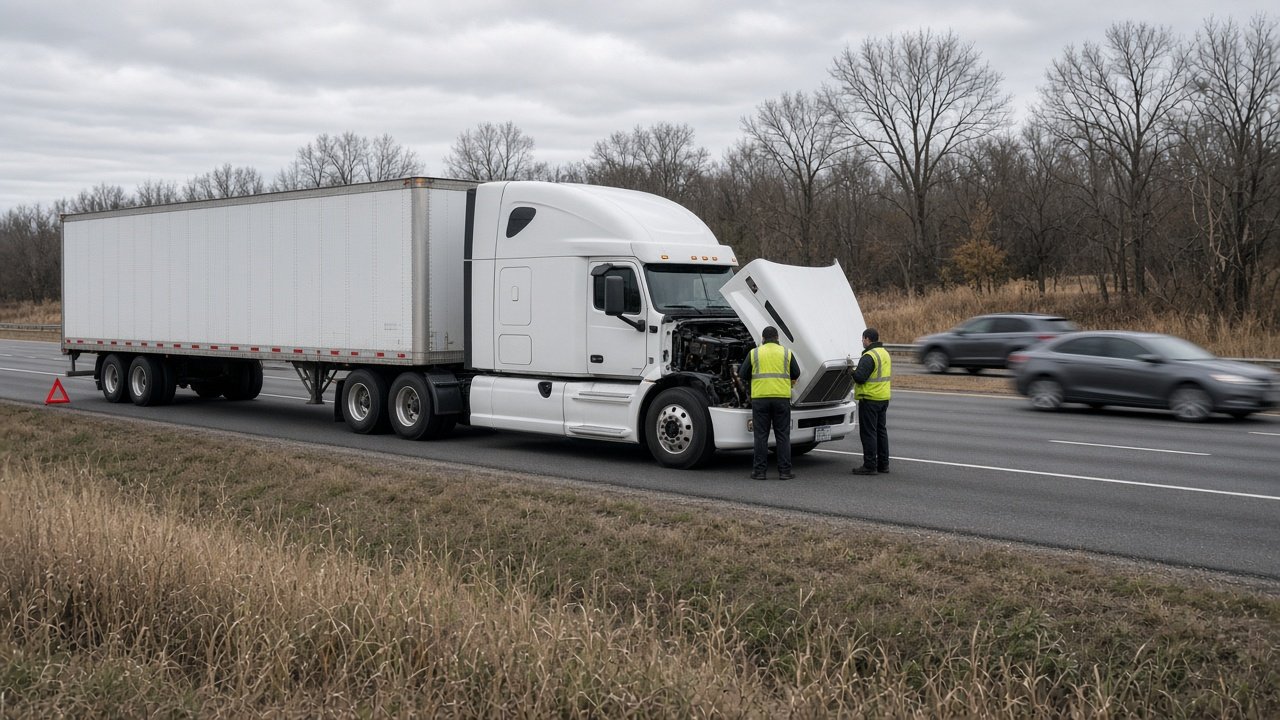
If your semi truck breaks down on the highway, federal rules give you a clear order of work: turn on your hazard flashers immediately, get the truck as far off the road as you safely can, and set out your three reflective triangles within 10 minutes. After that, call your carrier's breakdown line (or roadside service if you're an owner-operator), log the wait as on-duty not driving, and keep notes for breakdown pay. This guide walks through each step for CDL-A drivers, as of November 2026.
Searches like "mobile diesel mechanic near me" have been climbing on Google Trends this month, and November is a busy time to be stuck: holiday freight is heavy, days are short and a lot of the waiting happens in the dark. Knowing the routine before it happens saves time, money and maybe your life.
What should you do first when your semi breaks down?
- Signal and get off the road. Use whatever momentum you have to reach an exit, a wide shoulder or a pull-off. A ramp shoulder or a wide spot past a guardrail beats a narrow shoulder on a curve.
- Hazards on right away. Under 49 CFR 392.22(a), any time a CMV is stopped on the traveled lane or shoulder for anything other than normal traffic stops, you must turn on your flashers immediately and keep them on until your warning devices are out.
- Vest on, then exit on the safe side if you can. Check your mirrors before you open the door.
- Put out your triangles (details below), then make your calls.
- Stay away from the traffic side while you wait. If the shoulder is narrow and there's a safe spot behind a guardrail, many drivers wait there rather than in the cab.
Where do the triangles go on a semi truck breakdown?
Federal rules require three bidirectional reflective triangles (or at least six fusees) on every truck under 49 CFR 393.95(f). Section 392.22(b) says to place them as soon as possible and in any case within 10 minutes:
- Two-way road (standard rule): one about 10 feet (4 paces) behind the truck on the traffic side, one about 100 feet (40 paces) behind in the center of your lane or shoulder, and one about 100 feet ahead of the truck.
- Divided highway or one-way road: all three go behind you, toward oncoming traffic: one at 200 feet, one at 100 feet, and one within 10 feet of the rear of the truck on the traffic side.
- Near a hill, curve or other blind spot: if you're stopped within 500 feet of one, place a triangle 100 to 500 feet back toward the blind spot so drivers see it in time.
Fusees are fine as a backup, but never light a flame device near leaking fuel, and they aren't allowed at all on tankers hauling flammable liquids or gas, on trucks carrying Division 1.1 to 1.3 explosives, or on trucks fueled by compressed gas (393.95(g)). FMCSA removed old references to liquid-burning flares from these rules effective March 23, 2026 (Federal Register).
Do other drivers have to move over for a broken-down truck?
Not everywhere. All 50 states have Move Over laws, but only some cover disabled vehicles with hazards on, according to NHTSA. Don't count on passing traffic to give you room.
Who do you call after a breakdown?
- Company drivers: call your carrier's breakdown or maintenance line first. Most carriers have a set vendor list and approval steps, and they may refuse to pay for repairs you order on your own.
- Owner-operators: call your roadside assistance plan or a mobile diesel mechanic. Ask for a written quote that includes the call-out fee, hourly labor and parts before work starts.
- Call 911 if you're blocking a travel lane, stuck in a dangerous spot, there's a fire, or anyone is hurt.
Give whoever you call the details they need the first time: exact location (mile marker, direction, nearest exit), what failed and any dash codes, whether you're loaded, the trailer type, and whether the truck can be moved. If your ELD stops working because of the breakdown, follow our ELD malfunction steps.
How do you log a breakdown on your ELD?
Under the FMCSA definition of on-duty time in 49 CFR 395.2, "all time repairing, obtaining assistance, or remaining in attendance upon a disabled commercial motor vehicle" counts as on-duty time. So the hours you spend setting triangles, talking to the shop and waiting with the truck are usually logged as on-duty not driving. That time eats into your 14-hour window and your 60/70-hour limit, but not your 11 hours of driving. Ask your safety department before you log that time any other way.
One upside: a 30-minute stretch of on-duty, not-driving time counts toward your required 30-minute break, so a long wait usually takes care of it.
Worked example (hypothetical)
You come on duty at 6:00 a.m. and drive 5 hours. At 11:00 a.m. an air line fails on the interstate. You wait and help the mobile mechanic until 2:00 p.m., all logged on-duty not driving.
- 14-hour window: 6:00 a.m. + 14 hours = 8:00 p.m., so you have 6 hours left when you roll at 2:00 p.m.
- Driving time: 11 − 5 = 6 hours left.
- 30-minute break: already done, thanks to the 3-hour wait.
So you can drive up to 6 more hours, until 8:00 p.m. If the repair had run until 5:00 p.m., you'd only have 3 hours of driving before your window closes, even with driving hours left. That's the moment to call dispatch about the appointment and to start looking for a spot on our truck parking map. For more on fitting time and stops together, see our trip planning guide.
Do you get paid while your truck is broken down?
It depends on your carrier's policy. Many carriers pay breakdown pay as a flat amount or hourly after a set number of hours, and some pay nothing. Your logs and notes are your proof, so write down when the truck stopped, when you called, every promised arrival time and when you rolled again. Our guide to detention, layover and breakdown pay covers what to ask for. If your carrier doesn't pay for breakdowns and you lose days to bad equipment, that's worth weighing when you compare jobs on our CDL-A jobs board.
Common mistakes after a semi truck breakdown
- Stopping on a curve or hill crest when you had enough roll to reach a better spot.
- Making calls before setting triangles. The 10-minute clock is a legal limit, and an unlit truck at night is a target.
- Setting triangles too close together, or all ahead of the truck on a divided highway.
- Standing on the traffic side or sitting in the sleeper on a narrow shoulder.
- Approving repairs without authorization from your carrier, then getting stuck with the bill.
- Not logging the wait as on-duty, or not writing down times for breakdown pay.
- Skipping the pre-trip. Many breakdowns start as things a good pre-trip inspection would catch: air leaks, tire damage, loose hoses and low fluids.
What should you carry for a breakdown?
Beyond the required triangles, a charged fire extinguisher and spare fuses, keep a reflective vest, a strong flashlight and headlamp, work gloves, a phone power bank, water, snacks and warm layers. November nights get cold fast if the truck loses power. Our winter emergency kit list covers the cold-weather extras. Once you're rolling again, use our truck stop finder to get to a shop or safe stop, and check diesel prices if you need fuel along the way.
Frequently asked questions
How long do I have to put out triangles after a breakdown?
As soon as possible, and in any case within 10 minutes, under 49 CFR 392.22(b). Keep your hazard flashers on until they're out.
Can I use only my hazard lights?
No. Flashers are only allowed in addition to the required warning devices, not instead of them. Inside a business or residential district you may not need triangles when street lighting makes the truck clearly visible from 500 feet.
Is waiting for a tow logged as off duty?
Under the FMCSA definition, time spent repairing, getting help or staying with a disabled truck is on-duty time. Check with your safety department before logging it any other way.
Know a CDL-A driver tired of losing days to breakdowns and bad equipment? Refer them to us and earn $500. Refer a driver here.
Free for CDL-A drivers: get our Job Offer Checklist — 23 questions to ask any carrier about pay, miles and home time before you sign. Download the free checklist →
Know a CDL-A driver looking for work? Refer them and earn $500 when they complete 30 days on the road. Refer a driver →
CDL Transportation Group | CDL-A OTR Driver Recruiting