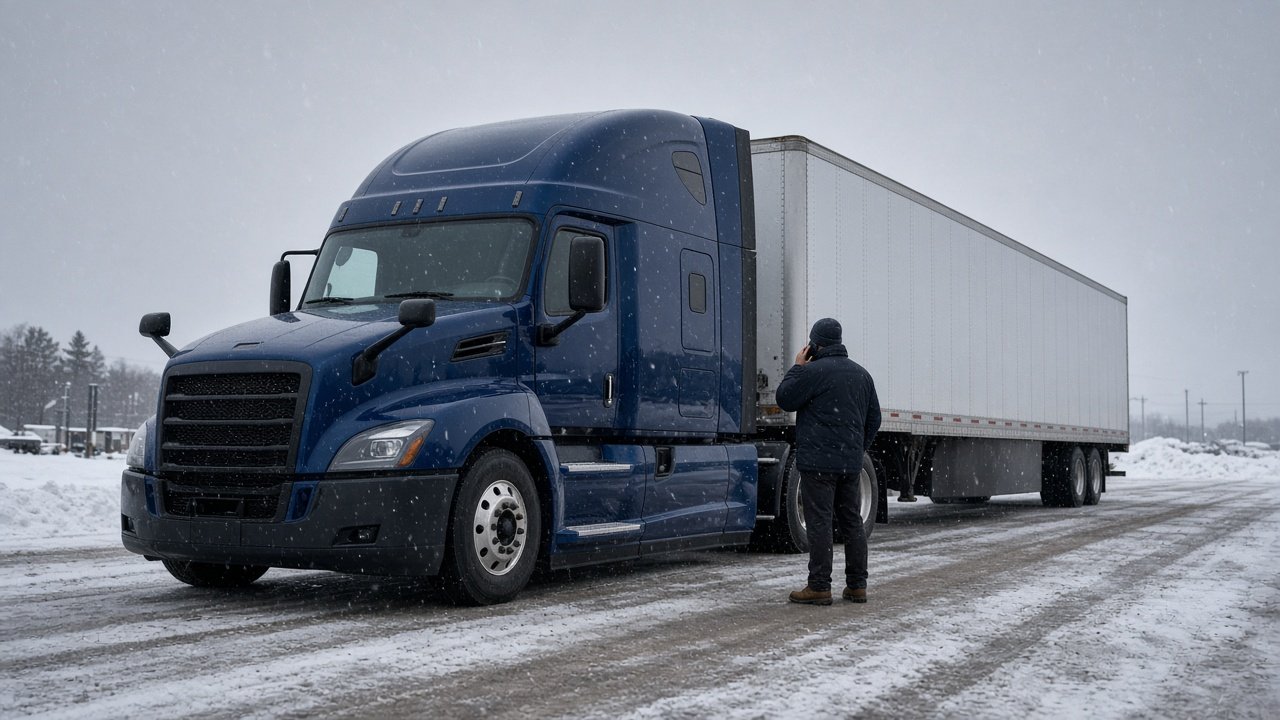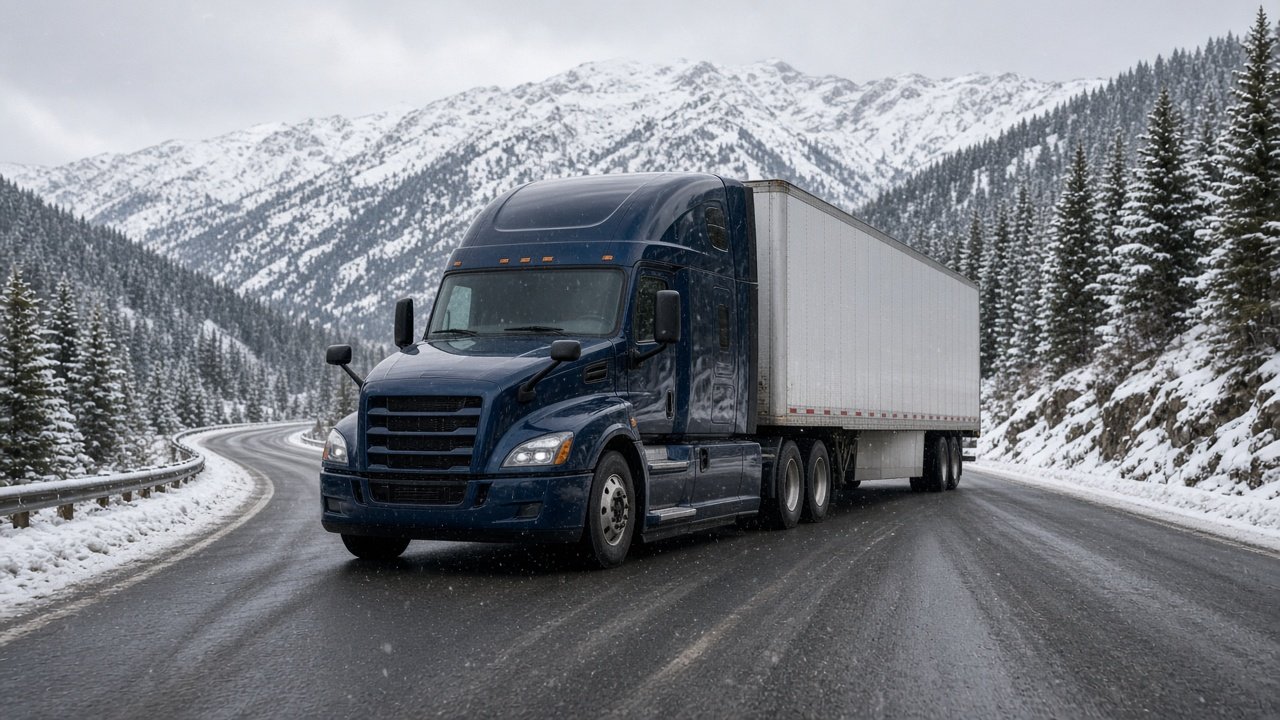
When a mountain pass closes, you stop. As of November 2026, state DOTs can shut or hold I-70 over the Eisenhower Tunnel and Vail Pass, I-80 over Donner Summit, I-90 over Snoqualmie Pass and other freight corridors with little warning. Check the official state road site or 511 before you climb, park legally below the closure if the route is already shut, and do not try to beat a gate. 49 CFR 392.14 requires extreme caution in snow, ice, sleet or fog, a lower speed, and a shutdown if conditions become too dangerous to operate safely.
That matters this week. Mid-November is when the first real winter storms start closing western passes, and even a clear day can bring a truck-only hold. On November 8, 2026, Caltrans highway information required all westbound trucks on I-80 to stop at the brake-check area west of Nyack to reduce brake-fire risk, while the pass itself stayed open.
How do I check if a mountain pass is closed?
Use the state DOT's own road page or 511, not a social-media rumor. CDOT tells travelers to check COtrip.org or the COtrip Planner app and call 511 before running the I-70 mountain corridor. Caltrans points drivers to Caltrans QuickMap and 800-427-7623. Bookmark these before you leave the last truck stop:
- Colorado: COtrip.org, the COtrip Planner app, or 511 for I-70, the Eisenhower Tunnel, Vail Pass and Loveland Pass.
- California: Caltrans QuickMap or 800-427-7623 for I-80 Donner Summit, I-5 Tejon/Grapevine and I-15 Cajon. Codes are explained on Caltrans' winter driving pages.
- Washington: WSDOT real-time travel or 511 for I-90 Snoqualmie and other Cascade passes.
- Oregon: Oregon TripCheck mountain passes for I-5 Siskiyou Summit and I-84 Cabbage Hill.
- Wyoming: WYDOT 511 for I-80 snow and wind closures. Wyoming also closes stretches by vehicle weight in high wind; see our high-wind blowover guide.
If the run crosses more than one mountain state, check each feed before you climb. For chain-up rules, see our truck chain laws by state guide.
What do truck-only holds and codes mean?
A pass does not have to be fully closed to stop you. As of November 2026, Caltrans codes that often stop CDL-A trucks on I-80 over Donner Summit and other California mountain routes, even when cars are still rolling, include:
- TS — trucks must stop and show maximum chains. Trucks without them get turned around, and permit loads are prohibited over the summit.
- TH — truck-trailer combinations are being held for weather or an incident.
- TTA, TTS or TTSD — certain truck-trailer or doubles combinations are being turned around for traction problems.
- HT — all traffic is being held. RC — the road is closed.
Caltrans says control areas can change rapidly and that you must follow posted signs and checkpoint officers, even if a radio report says something else. When chains are required, the posted speed is 25 or 30 mph. If you are turned around, drop back to a lower-elevation truck stop or rest area and recheck QuickMap.
Colorado works differently. CDOT may meter traffic at the Eisenhower Tunnel when volume, a crash or weather backs traffic into the tunnel. Stops often last about 20 minutes. That is not a storm closure, but it still burns time on your clock.
What should I do when a mountain pass is already closed?
Do not wait in a travel lane or on a narrow shoulder. Get to legal truck parking below the closure, tell dispatch your location and the official DOT status, and stay put until the state says commercial traffic can go. Before you climb, pick a fallback lot on the low side, keep enough fuel to sit through a hold (check diesel prices before you top off), and agree on a reroute if the closure may outlast your window. Holiday weeks fill lots early; see our holiday peak-season guide.
If the feed still shows the pass open but the weather is clearly unsafe, you still have the duty to shut down under 392.14. A closed gate is the state's decision; a whiteout or black ice is yours. For ice on decks and ramps, see our black ice on bridges guide.
How do mountain pass closures affect my hours-of-service clock?
A closure does not pause your 14-hour window by itself. If you are creeping in a queue or remaining ready to roll the moment the road opens, that time is generally on-duty under 49 CFR 395.2. If you are parked, your carrier has relieved you from work, and you are resting, that time can be logged off-duty or sleeper berth. Regular off-duty time that is not a qualifying sleeper-berth split does not stop the 14-hour clock. This is general information — ask your safety department how your company wants weather holds recorded.
There is a narrow extra-time rule. Under 49 CFR 395.1(b), if you hit adverse driving conditions and cannot safely finish the run or reach a safe place within your normal limits, you may drive up to two extra hours. Adverse conditions in 395.2 are snow, ice, sleet, fog or unusual road or traffic conditions that were not known, and could not reasonably have been known, to you at the start of the duty day or after a qualifying break, or to the carrier when it dispatched you. A forecast storm dispatch could see before you left often will not qualify. The extra two hours are to reach a safe place, not an unsafe summit.
Worked example: a hypothetical I-70 hold
Hypothetical: you come on duty at 6:00 a.m. in Denver and roll westbound on I-70 at 7:00 a.m. toward Grand Junction. COtrip showed the corridor open when you left. Around 11:00 a.m., CDOT closes Vail Pass after you have been driving about four hours. Your 14-hour window still ends at 8:00 p.m. If you park legally near Silverthorne or Frisco and stay in readiness because dispatch wants you rolling the moment the pass opens, those wait hours stay on-duty. If the pass reopens at 3:00 p.m., you have five hours left in the window to cross and find the next safe stop. If you instead take a qualifying sleeper split (at least seven hours in the berth plus another period of at least two hours, totaling at least ten), you can recast the window, but you will not be first in line when the gate lifts. Either choice beats running out of hours on the mountain with nowhere legal to sit.
What if I am pulling a placarded hazmat load on I-70?
Placarded hazardous materials are not treated like a regular dry van at the Eisenhower-Johnson Memorial Tunnels. Colorado's rules in 2 CCR 601-8-3.00 require placarded loads to use Loveland Pass (U.S. 6) whenever that pass is open. Loveland is a high, switchback two-lane route, and winter weather closes it often. When it is closed, CDOT may escort certain permitted hazmat loads through the tunnel, usually at the top of the hour, which shuts the tunnel to other traffic for about 15 minutes according to CDOT's tunnel page. Colorado's commercial vehicle guidebook, as of August 2026, states that explosives and highly corrosive substances are never allowed through the tunnel. Peak-period blackouts also keep westbound placarded loads out Saturday and Sunday mornings from 7:01 to 9:59 a.m., and eastbound loads out Sunday afternoons from 2:01 to 6:59 p.m., with similar limits on listed national holidays. Off-peak escorted moves run on the hour, and between 11:00 p.m. and 6:00 a.m. they can also run on the half hour. Do not stage in the tunnel-mouth lots; after designated spaces fill, the rules point drivers to Herman's Gulch (Exit 218), Officer's Gulch (Exit 198) or other rest areas.
Common mistakes
- Climbing on a stale report. Recheck COtrip, QuickMap, WSDOT, TripCheck or WYDOT at the last stop below the pass, not just at dispatch.
- Waiting on the shoulder. Shoulders below a closed gate become crash zones. Drop back to a truck stop or rest area.
- Treating a truck hold like an open road. TS, TH and TTA codes can screen, hold or turn you around even if cars are still moving.
- Assuming a weather delay pauses your 14-hour clock. It does not, unless you take qualifying rest after you were actually relieved from work.
- Counting on the two-hour adverse-condition exception for a forecast storm. If you or the carrier could reasonably have known about the weather before the run started, that extra time may not apply.
- Forgetting a placarded load cannot use Eisenhower Tunnel when Loveland Pass is open. That can leave you at a gate with no legal way over the divide.
General winter technique is covered in our winter driving tips for CDL-A drivers. If you want help comparing outfits that will back you when you shut down for weather, you can see matching options or browse open CDL-A jobs.
Frequently asked questions
Where can I check mountain pass closures for trucks?
Use COtrip or 511 in Colorado, Caltrans QuickMap or 800-427-7623 in California, WSDOT real-time travel in Washington, Oregon TripCheck, and WYDOT 511 in Wyoming. Recheck at the last stop before the climb.
Can I keep driving if cars are still going over the pass?
Not always. California can hold or turn around truck-trailer combinations while other traffic continues. Follow the posted truck restriction, not what four-wheelers are doing.
Does a closed mountain pass pause my 14-hour HOS window?
No. The window keeps running unless you take qualifying rest after being relieved from work. Sitting in a queue or remaining ready to roll is generally on-duty time.
Do I get two extra driving hours when a pass closes?
Only if the conditions meet 49 CFR 395.1(b) and 395.2: they were not known and could not reasonably have been known when you were dispatched or started the duty day or a qualifying break. The extra time is to reach a safe place, not to cross an unsafe summit.
Can a placarded hazmat load use the Eisenhower Tunnel?
Not when Loveland Pass (U.S. 6) is open. When Loveland is closed, CDOT may escort certain permitted placarded loads through on a set schedule. Explosives and highly corrosive loads are never allowed.
Know a CDL-A driver who is tired of getting pressured over a closed pass? Refer them to us. It's free for drivers. Refer a driver here.
Free for CDL-A drivers: get our Job Offer Checklist — 23 questions to ask any carrier about pay, miles and home time before you sign. Download the free checklist →
Know a CDL-A driver looking for work? Refer them and earn $500 when they complete 30 days on the road. Refer a driver →
CDL Transportation Group | CDL-A OTR Driver Recruiting