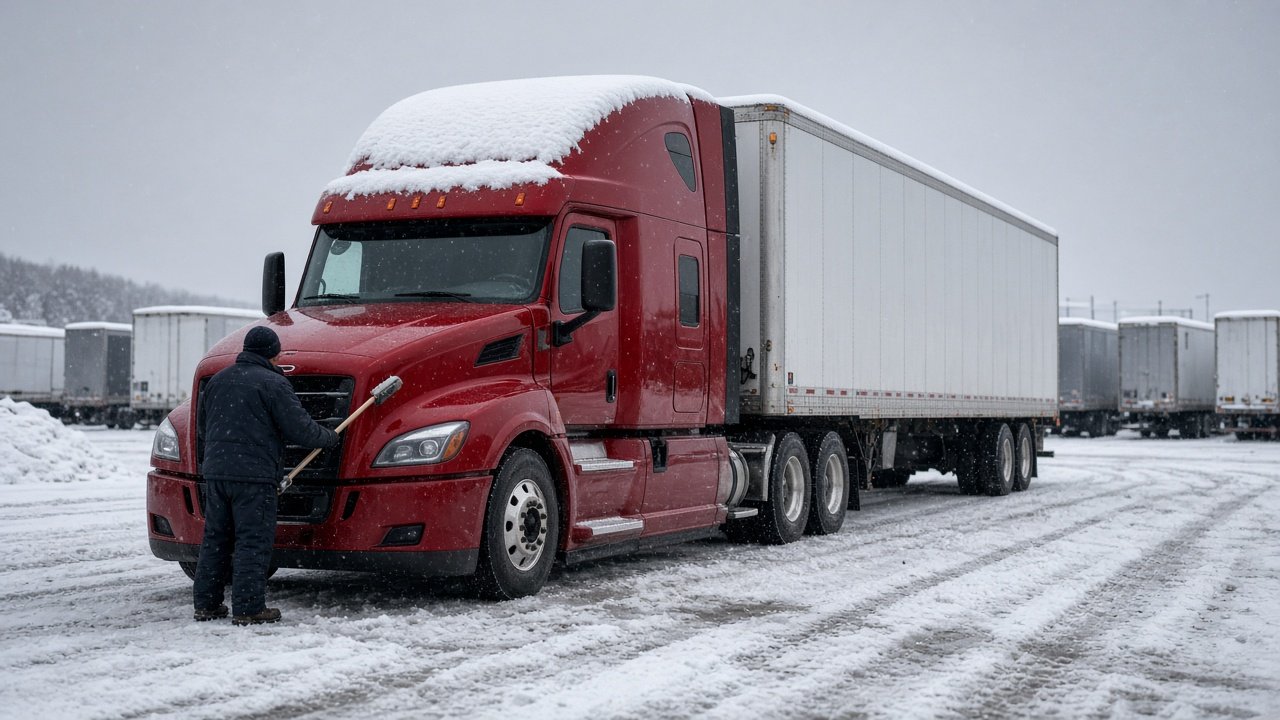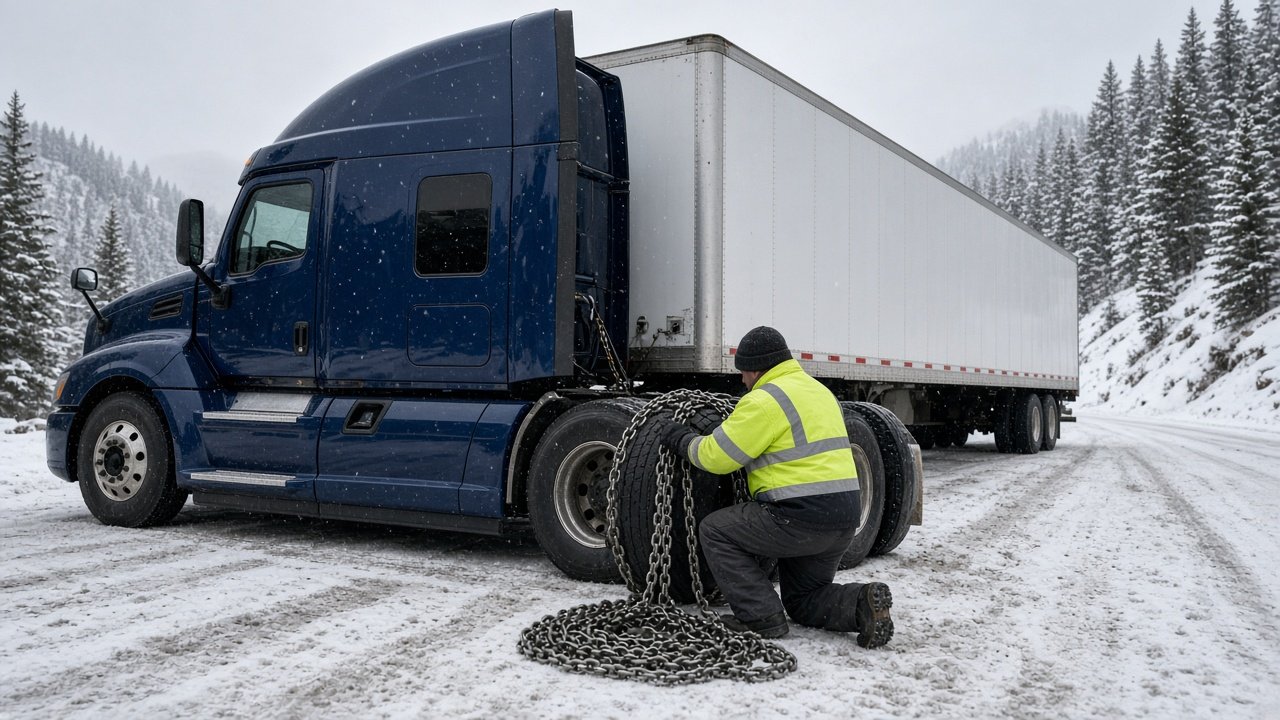
Truck chain laws kicked in for the 2026-27 season this fall. As of November 2026, Colorado requires CDL-A trucks to carry chains on I-70 west of Morrison and six other mountain corridors from September 1 to May 31, Washington requires vehicles over 10,000 pounds to carry chains on I-90 over Snoqualmie and other passes from November 1 to April 1, and Oregon and California require you to chain up whenever chain controls are posted, snow tires or not. On a typical tractor-semitrailer, that means chains on four drive tires plus at least one trailer axle in most states. Here's what each western state wants, and how to stay out of trouble.
Which states have truck chain laws?
Almost every snow state can require chains when roads get bad, but four western states write specific rules for heavy trucks, and those are where most CDL-A drivers get cited or stuck: Colorado, Washington, Oregon and California. Idaho, Montana, Nevada, Utah and Wyoming also post chain or traction restrictions on mountain routes, so check the state 511 or DOT road site before every mountain run.
Colorado chain law for trucks: what is the "Must Carry" rule?
Colorado's Commercial Motor Vehicle chain law applies to any CMV with a GVWR or GCWR of 16,001 pounds or more. From September 1 through May 31, you must carry chains or approved alternate traction devices (ATDs) on these corridors, no matter what the weather is doing:
- I-70 west of MP 259 (Morrison)
- US 40 west of MP 256 (Empire)
- US 285 west of MP 250 (Morrison)
- CO 9 from MP 63 to MP 97 (Frisco to Fairplay)
- US 50 west of MP 225 (Salida)
- US 160 west of MP 304 (Walsenburg)
- US 550 from MP 0 to MP 130
When CDOT activates the chain law, you need chains or ATDs on at least four drive tires. Clip-on chains are not allowed. You're also restricted to the right lane except to pass a stalled or slower vehicle without losing traction.
Fines, according to CDOT's chain law fact sheet (as of November 2026): $100 plus a $32 surcharge for not carrying chains, up to $500 plus a $78 surcharge for not chaining up when the law is active, and $1,000 plus a $156 surcharge if you spin out and block the road. Oversize and overweight permit loads also face winter travel-time restrictions on I-70 between West Vail and Morrison from December 1 to March 31.
Washington chain requirements: when must trucks carry chains?
Under WAC 204-24-050, vehicles over 10,000 pounds GVWR must carry enough chains from November 1 to April 1 on designated routes, regardless of conditions. The big ones for OTR freight are I-90 between North Bend (MP 32) and Ellensburg (MP 101) over Snoqualmie Pass, I-82 between Ellensburg and Selah, US 2 over Stevens Pass, US 97 over Blewett and Satus passes, and US 12 over White Pass. WSDOT's chain page lists them all.
Washington also requires every truck over 10,000 pounds to carry at least two extra chains in case conditions get worse or a chain breaks. Chains must be two-sided, hardened metal and not plastic; cable chains are allowed. WSDOT or the State Patrol can stop trucks without chains from entering chain areas.
Oregon chain law: do trucks have to carry chains?
Yes, whenever conditions might require them. ODOT says all commercial vehicles over 10,000 pounds GVW must carry chains whenever road conditions might require them or Snow Zone signs are posted, and the law applies on every Oregon highway. There's no fixed carry season, so in practice, carry them all winter.
For a tandem-drive tractor pulling a semitrailer, ODOT's rules say you need chains on two tires on each side of the primary drive axle (or one tire on each side of each drive axle if both are powered), plus two tires, one on each side, of any semitrailer axle. In very bad conditions ODOT can issue a conditional closure where everyone chains up. That happens often on I-5 over the Siskiyou Pass south of Ashland.
California chain controls: what do R-1, R-2 and R-3 mean for trucks?
California doesn't have a fixed carry season, but Caltrans is clear that heavy commercial vehicles get no snow-tire exemption: if chain controls are posted, you chain up. R-1 and R-2 are the common levels, and a road usually closes before R-3. On a tractor-semitrailer, 13 CCR 1072 calls for chains on at least four tires of the drive axle(s) and at least two tires of one semitrailer axle.
On I-80 over Donner Summit, watch the Caltrans chain control status codes. "TS" means trucks must stop at the checkpoint and show maximum chains or get turned around, and "MAX" means maximum chain requirements are in effect. Caltrans says you'll usually have about a mile between the "Chains Required" sign and the checkpoint.
Worked example: how many chains should you carry?
Hypothetical: you're running a tandem-drive tractor with a 53-foot dry van from Salt Lake City to Seattle on I-84 and I-90, then back through Colorado on I-70 next week.
- Drive tires to chain under the strictest rules on your route: 4
- Trailer: one axle, 2 tires: 2
- Washington's two extra chains: 2
- Total: 4 + 2 + 2 = 8 chains on board
If you'd only carried the four drive chains you'd use in Colorado, you'd be short for Oregon and California trailer requirements and for Washington's spares. Many drivers carry enough for "maximum" chain-up so a checkpoint never turns them around.
Common mistakes with truck chain laws
- Waiting until the checkpoint. Chaining in the dark on a shoulder with traffic going by is how drivers get hurt. Use the posted chain-up areas, and put chains on before you're sliding.
- Carrying chains you've never fitted. Practice once in a dry lot. Wrong-size chains are useless when you need them.
- Forgetting the trailer axle. Oregon and California both require chains on the trailer, not just the drives.
- Trusting the radio over the sign. Caltrans says to follow posted signs and checkpoint officers even when broadcast reports say something else.
- Not planning parking. When a pass closes, the truck stops below it fill fast. Check truck parking and truck stops on your route before you climb.
- Ignoring your clock. Chain-ups and pass holds burn hours. Plan your 14-hour window so a closure doesn't leave you out of hours on a mountain.
Chains are only part of the picture. Read our winter driving tips for CDL-A drivers, how to prevent frozen air brakes, and our diesel gelling guide, and check diesel prices before you top off ahead of a long climb.
Frequently asked questions
Do semi trucks have to carry chains in Colorado?
Yes. From September 1 to May 31, CMVs of 16,001 pounds or more must carry chains or approved ATDs on I-70 west of Morrison and six other listed corridors, even on dry roads.
When do trucks have to carry chains in Washington?
From November 1 to April 1 on designated mountain routes like I-90 over Snoqualmie Pass, plus at least two extra chains at all times for vehicles over 10,000 pounds.
Can I use snow tires instead of chains on a semi in California?
No. Caltrans says heavy commercial vehicles over 6,500 pounds have no snow-tire exemption and must chain up when controls are posted.
Are AutoSocks or tire socks legal for trucks?
It depends on the state. Colorado allows ATDs on its approved product list, and Washington lets the State Patrol approve chain-equivalent devices. Check the state's current list before relying on them.
What happens if I get stuck without chains?
Expect a ticket and possibly a big one. Colorado's fine for blocking the road is $1,000 plus a surcharge as of November 2026, and you can also be turned around at checkpoints in Washington and California.
Know a CDL-A driver heading into chain season without a carrier that has their back? Refer them to us. It's free for drivers. Refer a driver here.
Free for CDL-A drivers: get our Job Offer Checklist — 23 questions to ask any carrier about pay, miles and home time before you sign. Download the free checklist →
Know a CDL-A driver looking for work? Refer them and earn $500 when they complete 30 days on the road. Refer a driver →
CDL Transportation Group | CDL-A OTR Driver Recruiting