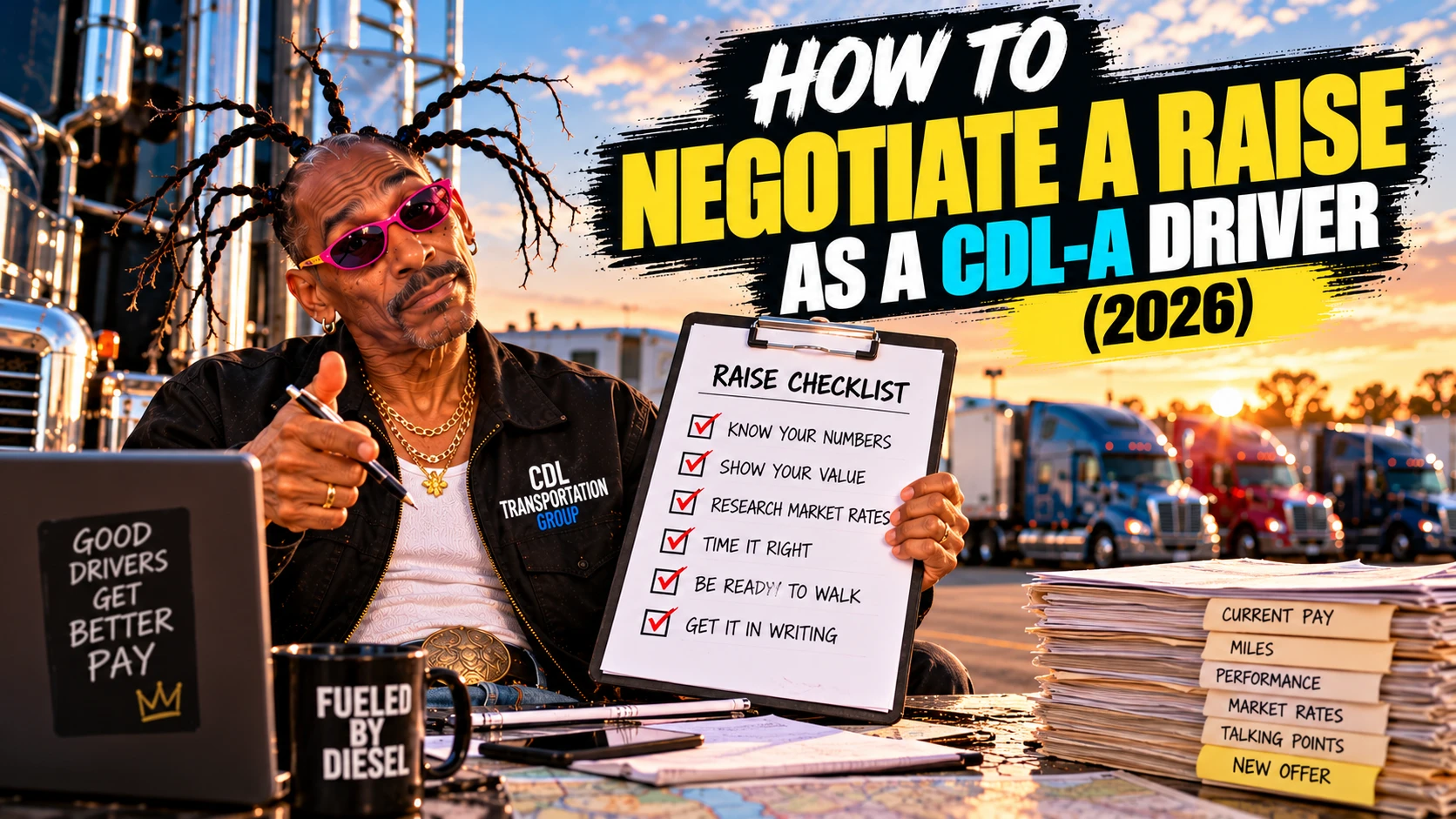
To negotiate a raise as a CDL-A driver, show up with documented numbers, ask for a specific cents-per-mile increase or a specific guarantee, and ask at a moment when your carrier needs you to stay. A calm, prepared request backed by your safety record and miles gets far better results than "I think I deserve more." Here is how to do it step by step, as of October 2026.
When is the best time to ask for a raise?
Timing matters nearly as much as the number. Good moments include:
- After a clean annual stretch. No at-fault accidents, no preventable inspection violations, no service failures.
- At your work anniversary or right after a review. Many carriers already have a pay conversation built into these dates.
- When the carrier is short on trucks. If your fleet manager is struggling to cover freight, your leverage goes up.
- When you take on something harder. A new endorsement, a tougher account, or training a newer driver all justify a conversation.
Avoid asking right after a late delivery, a write-up, or a rough week with dispatch. Wait until your record speaks for itself.
What should you know before you ask?
Do your homework first. The Bureau of Labor Statistics reports a median pay of $58,640 per year ($28.19 per hour) for heavy and tractor-trailer truck drivers as of May 2025, according to the BLS Occupational Outlook Handbook. That is a national median across all types of driving, so treat it as a rough reference, not a target. Your own market (lane, freight type, region, experience) matters more.
Then gather your own numbers:
- Your average weekly miles and your average weekly pay over the last 6 to 12 months.
- Your effective pay per mile after unpaid time (waiting, layovers, short weeks). Our guide to what a fair CDL-A pay-per-mile rate looks like shows how to compare.
- Your safety and service record: years accident-free, on-time percentage if you have it, clean inspections.
- What similar jobs are offering. Browse current openings on our CDL-A job board and run a quick comparison with the job match quiz.
How do you ask for a raise step by step?
- Ask for a scheduled conversation. Send a short message to your fleet manager or driver manager: "Can we set a time this week to talk about my pay?" Do not ambush them on a bad day over the phone while they are covering ten loads.
- Open with your value. Lead with your record and reliability. Keep it factual: miles run, years with the company, clean history.
- Name one clear request. For example, "I would like to move to X cents per mile" or "I would like my home time guarantee in writing." Vague asks get vague answers.
- Back it with market information. Mention that you have seen comparable CDL-A positions in your lane type offering more, without being threatening about it.
- Stop talking and listen. Let them respond. Silence after an ask is normal.
- Get the answer in writing. If they agree, ask for an email or updated pay sheet showing the new rate and its start date.
A worked example (hypothetical)
This is a hypothetical example to show the math, not a promise of what any carrier pays. Say a driver runs about 2,500 paid miles per week at 55 cents per mile, which is $1,375 per week. They ask for a 3 cent increase to 58 cents per mile.
- 3 cents x 2,500 miles = $75 more per week.
- $75 x 50 working weeks = $3,750 more per year, before taxes.
Small per-mile changes add up. If the carrier says no to the full 3 cents, a counter at 2 cents ($50 per week, or $2,500 per year) is still a real gain. Work out your acceptable range before you walk in.
What if the carrier says no to a raise?
A "no" on cents per mile does not have to end the conversation. Other items can be worth real money:
- Better detention, layover, or breakdown pay. See what drivers should be paid for waiting time.
- A guaranteed minimum weekly pay or mileage.
- Better equipment or a newer truck.
- A firm home time schedule in writing.
- A retention or safety bonus. Read the fine print first, as covered in our sign-on bonus guide.
Ask: "What would it take to get to this number in six months?" A clear answer gives you a target. A vague answer tells you something too.
When is it time to look elsewhere?
If your pay is clearly below what comparable jobs offer, your record is solid, and the carrier will not commit to anything, it may be time to move. Before you do, read our checklist for switching trucking companies and the questions to ask a recruiter. Do not quit before you have an offer in writing.
What are the common mistakes when asking for a raise?
- Asking without numbers. "I want more" is hard to say yes to.
- Comparing yourself to other drivers. Coworker pay is a touchy subject and often not comparable. Focus on your own value and the market.
- Making ultimatums you will not follow through on. Only say you will leave if you truly will.
- Ignoring the total package. Cents per mile is one piece. Unpaid time, deductions and home time also drive what you actually take home.
- Accepting a verbal promise. If it is not written down, it can be forgotten or changed by the next manager.
- Burning bridges. Stay professional even if the answer is no. You may want to come back, or need a reference.
Frequently asked questions
How much of a raise should I ask for?
There is no universal number. Base your ask on your current effective pay per mile, local market offers for similar jobs, and your record. A modest, specific increase is easier for a manager to approve than a big jump.
Is it better to ask for a raise or switch carriers?
Try asking first if you like the job otherwise. If the carrier will not move and the market clearly pays more, switching can make sense. Compare the full package, not only the headline rate.
Can I ask for a raise by text or email?
Use text or email to request a meeting, and have the actual conversation by phone or in person. Then follow up in writing to confirm what was agreed.
Should I mention a competing offer?
Only if it is real and you are comfortable with the consequences. Be honest and professional. A fake offer can damage trust quickly.
What if my carrier pays by percentage or has a fixed pay scale?
Some pay structures have limited flexibility. Ask about other levers such as a different account, a different lane, bonuses, or guaranteed minimums. For fuel savings that also boost your take-home, see our diesel price tracker, and find places to park and rest with our parking finder.
This is general information, not financial or legal advice. Ask a qualified professional about your situation, and check the details of your own driver agreement. More tools for working drivers are on our drivers page.
Photo: Destroducks, CC BY-SA 4.0, via Wikimedia Commons.
Free for CDL-A drivers: get our Job Offer Checklist — 23 questions to ask any carrier about pay, miles and home time before you sign. Download the free checklist →
Know a CDL-A driver looking for work? Refer them and earn $500 when they complete 30 days on the road. Refer a driver →
CDL Transportation Group | CDL-A OTR Driver Recruiting