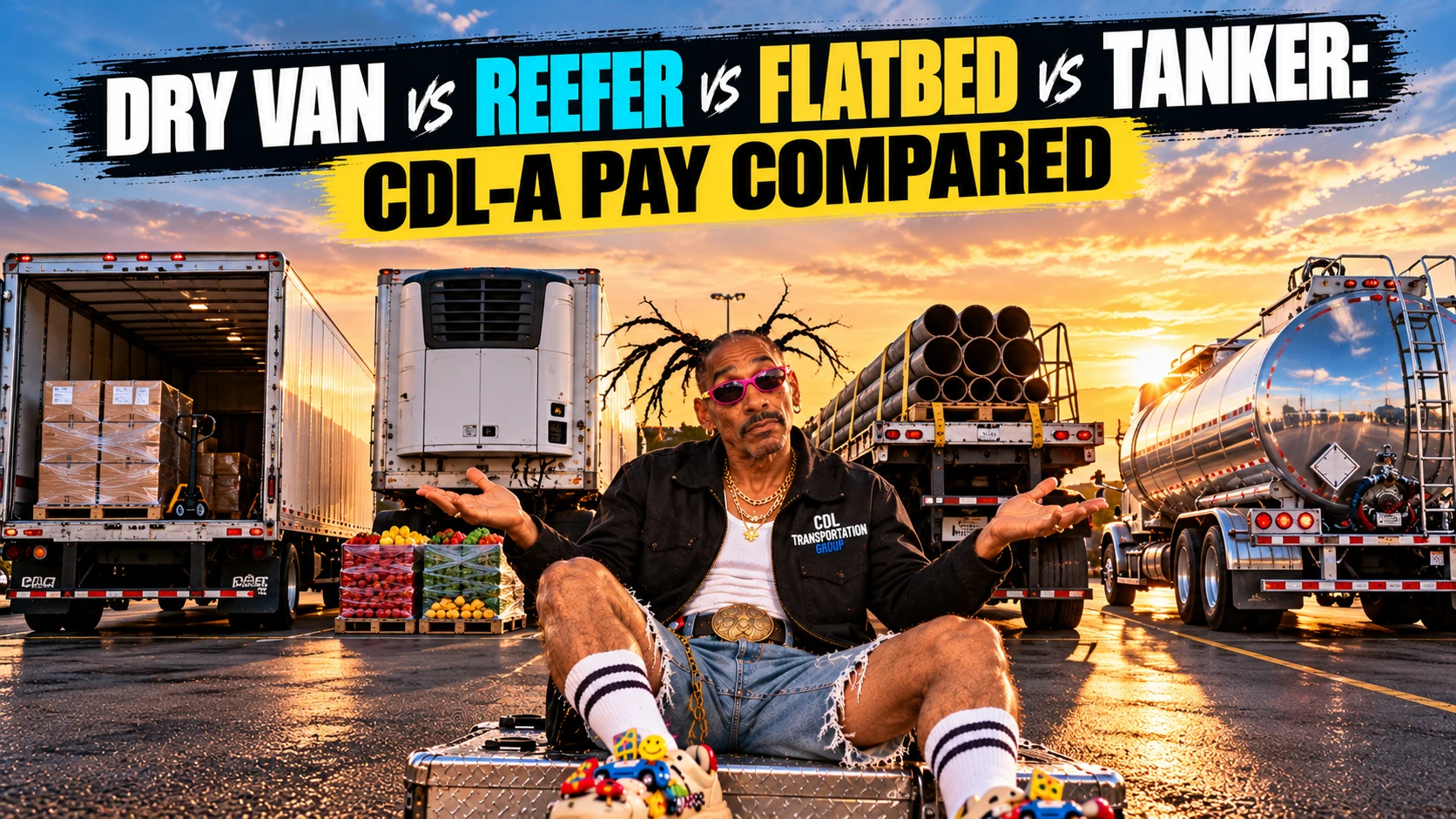
Dry van is usually the easiest freight to find and the steadiest on miles, reefer often pays a little more for more paperwork and pressure, flatbed pays the most per mile for the most physical work, and tanker pays well but needs an N endorsement. If you are weighing dry van vs reefer vs flatbed vs tanker as an experienced CDL-A driver, the right pick depends on how you value miles, body wear, home time and hassle, not on the highest posted cents per mile.
This guide compares the four on pay, lifestyle and requirements, with a worked example so you can see why the biggest rate does not always win. Pay figures below are ranges from public industry guides and vary a lot by carrier, lane and experience. They are not promises. Verify the offer in writing. Our post on how to read a CDL-A job offer shows what to check.
How much does each trailer type pay per mile?
As of October 2026, public pay guides put experienced OTR company-driver pay in these rough ranges. The sources sell services or ads and disagree with each other, so treat them as estimates only:
- Dry van: roughly $0.45 to $0.65 per mile, lowest of the four because it is the most common equipment and the most crowded market.
- Reefer: roughly $0.48 to $0.65 per mile, a small premium for temperature control and tighter delivery windows.
- Flatbed: roughly $0.52 to $0.75 per mile, often with extra tarp pay (one guide cites $50 to $100 per load).
- Tanker: roughly $0.55 to $0.72 per mile in one guide. Public tanker pay data is thin, so ask any carrier for its actual scale.
Do not mix these up with freight rates. Spot-market rates shippers pay per mile (one guide cites reefer spot at roughly $2.80 to $3.10 all-in, including fuel surcharge) are not driver pay. For the bigger picture, see CDL-A pay per mile in 2026.
Is dry van the best choice for steady miles?
Dry van is the default for a reason. Freight is everywhere, loads are usually no-touch or drop-and-hook, and you can often find work in any region. That makes it a good fit if you want consistent weekly miles and predictable days.
- Pros: plentiful loads, low physical work, easy to switch carriers, simple equipment.
- Cons: lowest base pay of the four, lots of competition, and detention at shippers is common. Know what you are owed. See detention, layover and breakdown pay.
Is reefer worth the extra stress?
Reefer hauls temperature-controlled freight such as food, produce and pharmaceuticals. The pay edge over dry van is modest, and you take on more responsibility: pre-cooling, watching set points, fuel for the reefer unit, and strict appointment times.
The FDA's sanitary transportation rule requires carriers that take on that role to maintain adequate temperature control, train personnel in sanitary practices and keep records. Some operations, such as those under $500,000 in annual revenue, are exempt. Your carrier handles most of the paperwork, but you are the one who can protect a load.
- Pros: slightly better pay, steady year-round freight, strong demand during produce season.
- Cons: rejected-load risk if temperatures drift, noisy reefer unit at night, tight delivery windows that squeeze your hours of service.
Does flatbed really pay more, and what does it cost your body?
Flatbed usually has the highest base cents per mile, because you strap, chain and tarp your own freight. Securement is the core skill. Under 49 CFR 392.9, you must check cargo and securement devices within the first 50 miles of a trip, then re-check whenever you change duty status, after 3 hours of driving, or after 150 miles, whichever comes first. The securement standards themselves are in 49 CFR Part 393, Subpart I.
- Pros: higher base pay, tarp and extra-stop pay at many carriers, more variety, often less waiting on dock doors.
- Cons: hard on shoulders, knees and back, bad weather while tarping, more work off the clock unless the carrier pays for it, and a securement violation lands on your record.
Ask whether tarping time counts as paid time and whether you are paid for each tarp. Those details can erase the rate advantage.
Do you need a tanker endorsement?
Yes, to drive a tank vehicle you need the N endorsement. 49 CFR 383.93 requires a knowledge test for it, and a CLP may carry the endorsement. If you haul hazardous materials, you also need the H endorsement, which requires a TSA security threat assessment. According to TSA, the fee is $85.25 for new and renewing applicants, with fingerprints required and renewal generally every five years (as of October 2026).
- Pros: endorsement-based pay premiums, less competition, often steady dedicated lanes.
- Cons: liquid surge when braking and turning, careful loading and unloading procedures, and extra safety and compliance obligations, especially with hazmat. Read up on the FMCSA drug out-of-service rules too, since a clean record matters more when you haul regulated freight.
Worked example: which one actually pays more?
This is a hypothetical example with made-up numbers to show the math, not a pay promise.
- Dry van: $0.55 per mile x 2,500 paid miles per week = $1,375.
- Flatbed: $0.65 per mile x 2,200 paid miles per week = $1,430, plus 3 tarped loads at $75 = $225. Total $1,655, but only if tarping is paid and you can handle the extra physical work.
- Reefer: $0.58 per mile x 2,400 paid miles per week = $1,392.
Flatbed wins on paper by about $280 a week, but if the flatbed carrier does not pay for tarping and you average 1,800 miles because of loading time, flatbed drops to $1,170 and dry van wins. Always compare weekly pay, not cents per mile. Use our free driver tools and the job match quiz to line up your own numbers.
Which trailer type fits your life?
- You want predictable miles and low physical strain: dry van.
- You want slightly more pay and can handle appointments and set points: reefer.
- You want the highest per-mile rate and do not mind physical work: flatbed.
- You want fewer competitors and will study for an endorsement: tanker.
Also think about the lanes you run. Flatbed freight clusters around construction, steel and building materials, while reefer follows produce and food distribution. Check current openings in your area, and plan fuel and parking with diesel prices, truck parking and truck stops. Our guide on OTR vs regional CDL-A jobs covers the other half of the decision.
Common mistakes when choosing equipment
- Chasing the highest CPM only. Weekly miles, unpaid time and extra duties decide what you take home.
- Not asking about tarping, stop and layover pay. Get it in writing.
- Underestimating the physical toll of flatbed. Try it with a short-term run before committing for years.
- Ignoring endorsement costs and timelines. Plan the knowledge tests and any TSA process before you leave your current job.
- Skipping the carrier check. A good trailer type with a bad carrier is still a bad job. Look the carrier up on FMCSA SAFER first.
Frequently asked questions
Is flatbed harder than dry van?
Physically, yes. You secure and tarp your own loads. Many drivers say the pay and variety are worth it, but it is not for everyone.
Does reefer pay more than dry van?
Often slightly, but the gap is small and varies by carrier. The real difference is the added responsibility for temperature and delivery times.
Do I need an extra endorsement for flatbed or reefer?
No. Neither requires its own endorsement. Tankers require N and hazardous materials require H, per 49 CFR 383.93.
Can I switch trailer types without starting over?
Yes, as an experienced CDL-A driver you can. Expect some carriers to want recent experience on the equipment, so ask about training for flatbed securement.
Which is best for home time?
It depends on the carrier and lane. Regional and dedicated jobs in any trailer type offer more predictable home time than long-haul OTR. Get your home-time promise in writing.
This is general information. Pay, rules and fees change, so confirm details with your carrier and the primary sources before you decide.
Photo: Hermann Luyken, CC0, via Wikimedia Commons.
Free for CDL-A drivers: get our Job Offer Checklist — 23 questions to ask any carrier about pay, miles and home time before you sign. Download the free checklist →
Know a CDL-A driver looking for work? Refer them and earn $500 when they complete 30 days on the road. Refer a driver →
CDL Transportation Group | CDL-A OTR Driver Recruiting