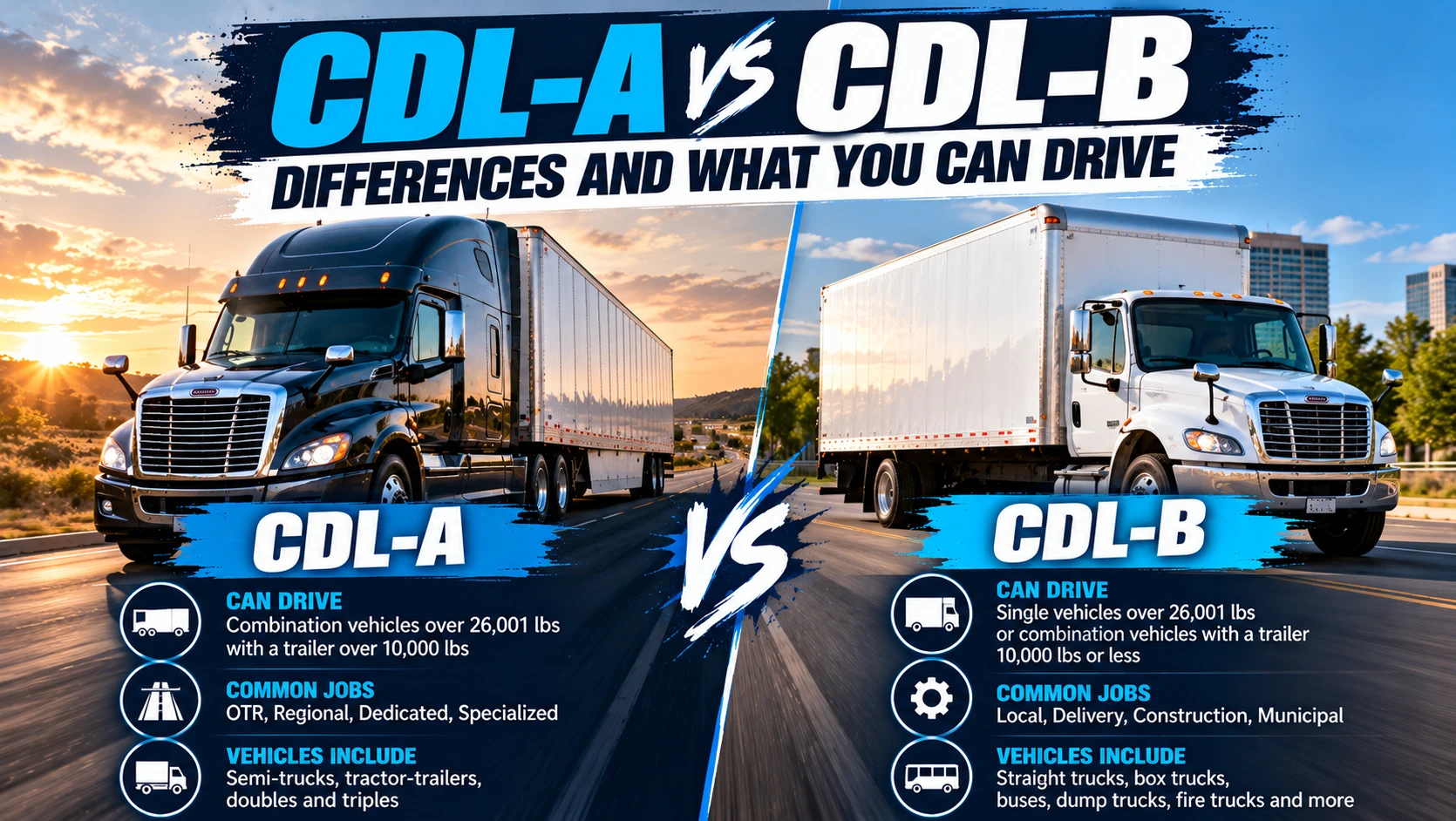
The difference comes down to what you pull. A Class A CDL lets you drive a combination vehicle, such as a tractor-trailer, when the combination weighs 26,001 pounds or more and the trailer being towed is over 10,000 pounds. A Class B CDL covers a single heavy vehicle with a GVWR of 26,001 pounds or more, such as a straight truck, dump truck or city bus, and only lets you tow a trailer of 10,000 pounds or less. If you want to drive an over-the-road tractor-trailer, you need Class A. As of October 2026, those are the federal definitions in 49 CFR 383.91.
What does Class A let you drive?
Federal rules define Group A as any combination of vehicles with a gross combination weight rating (GCWR) of 26,001 pounds or more, provided the vehicle being towed has a GVWR above 10,000 pounds. In practice that means:
- Tractor-trailers: dry van, reefer, flatbed, tanker and similar
- Truck-and-trailer combinations where the trailer is heavier than 10,000 pounds GVWR
- Doubles and triples, with the right endorsement
A Class A holder can also operate Class B and Class C vehicles, as long as they hold the endorsements those vehicles require. That makes Class A the most flexible license, and it is the one most long-haul and regional jobs ask for. Browse openings on our jobs page to see how many say "CDL-A required."
What does Class B let you drive?
Group B is any single vehicle with a GVWR of 26,001 pounds or more, or such a vehicle towing something that does not exceed 10,000 pounds GVWR. Typical Class B vehicles:
- Straight trucks and box trucks over 26,000 pounds
- Dump trucks and concrete mixers
- Garbage trucks
- Large buses (city buses, school buses, motorcoaches) with the right passenger endorsement
Class B jobs are often local, with home every night. They rarely involve long hauls, and you cannot drive a standard tractor-trailer with a Class B license.
What about Class C?
Class C covers vehicles that meet neither definition above but are designed to carry 16 or more passengers including the driver, or are used to transport hazardous materials that require placarding. Small hazmat vans and some shuttle buses fall here. Most drivers searching "CDL-A vs CDL-B" are not looking at Class C, but it is the third federal group.
Class A vs Class B: side-by-side
- Towing: A allows a towed unit over 10,000 lbs GVWR. B allows 10,000 lbs or less.
- Typical vehicles: A is tractor-trailers. B is straight trucks and buses.
- Typical work: A includes OTR, regional and local freight. B is mostly local, construction, delivery and transit.
- Can drive lower classes: A holders can drive B and C vehicles with proper endorsements. B holders can drive C vehicles with proper endorsements, but not Class A combinations.
Which one should you get?
Pick the license that matches the job you want, not the one that looks cheaper. Class A usually takes more training time and a combination-vehicle test, but it keeps the most doors open. If you are not sure, our driver match quiz can help you narrow down job types. Our guide on how much CDL training costs covers the money side, and how to get your CDL in 2026 walks through the steps.
Do you need training for Class A or Class B?
Yes. Anyone getting a Class A or Class B CDL for the first time, or upgrading from B to A, must complete entry-level driver training (ELDT) with a provider listed on the FMCSA Training Provider Registry before taking the skills test. The same rule applies the first time you get a Passenger (P), School Bus (S) or Hazmat (H) endorsement. See 49 CFR Part 380 for the rule. Check with the school about its program length and cost, because both vary.
Worked example: upgrading from B to A
This is a hypothetical example. Say a driver holds a Class B and drives a dump truck locally. A job opens up pulling a flatbed trailer weighing 14,000 pounds GVWR behind a tractor. The trailer is over 10,000 pounds, so the combination is Group A. The driver cannot take that job on a Class B. To qualify, they would complete ELDT for the Class A upgrade, pass the knowledge test and the skills test in a representative Group A vehicle, and then they could apply. Now compare a second job: a straight truck with a 26,500-pound GVWR and a small 6,000-pound trailer. The trailer is under the 10,000-pound limit, so this stays Group B.
Common mistakes
- Judging by the trailer length instead of weight. The class depends on GVWR and GCWR, not how long the trailer looks.
- Assuming Class B is "almost Class A." The skills test and the vehicle you are tested in differ, so plan on separate practice.
- Forgetting endorsements. Tanker, hazmat, doubles/triples and passenger work each require a separate endorsement on top of the class.
- Testing in the wrong vehicle. If you test in a Group B vehicle, your license is restricted to Group B.
- Skipping the registry check. Training from a school that is not on the Training Provider Registry will not count for ELDT.
Frequently asked questions
Can I drive a semi with a Class B license?
No. A standard tractor-trailer is a Group A combination. A Class B allows towing only a unit of 10,000 pounds GVWR or less.
Can a Class A driver drive a dump truck or bus?
Yes, with the proper endorsements. Group A holders may operate Group B and C vehicles.
Is Class A harder to get than Class B?
Class A adds combination-vehicle knowledge and a more involved driving test with a trailer. Many new drivers find coupling and uncoupling and backing the hardest part.
Which class pays more?
Pay depends on the job, region and experience more than the letter. Class A opens more job types, including long-haul work. See our pay breakdown for sourced ranges.
Do rules differ by state?
The federal classes are the same everywhere, but states set their own fees, testing sites and some details. Check your state licensing agency before you apply.
Planning where to rest on the road once you are licensed? See our truck parking map, the truck stop finder, and the diesel price tracker. More resources are on our drivers page.
This is general information. Ask your state licensing agency or a qualified professional about your situation.
Photo: Schilli, CC BY-SA 4.0, via Wikimedia Commons.
Free for CDL-A drivers: get our Job Offer Checklist — 23 questions to ask any carrier about pay, miles and home time before you sign. Download the free checklist →
Know a CDL-A driver looking for work? Refer them and earn $500 when they complete 30 days on the road. Refer a driver →
CDL Transportation Group | CDL-A OTR Driver Recruiting