CDL training usually costs between about $1,000 and $10,000 as of October 2026, depending mostly on the type of school. Community colleges tend to be the cheapest, private schools cost more, and some employer-sponsored programs charge nothing up front in exchange for a work commitment. Here is how to figure out what you will really pay.
How much does CDL training cost?
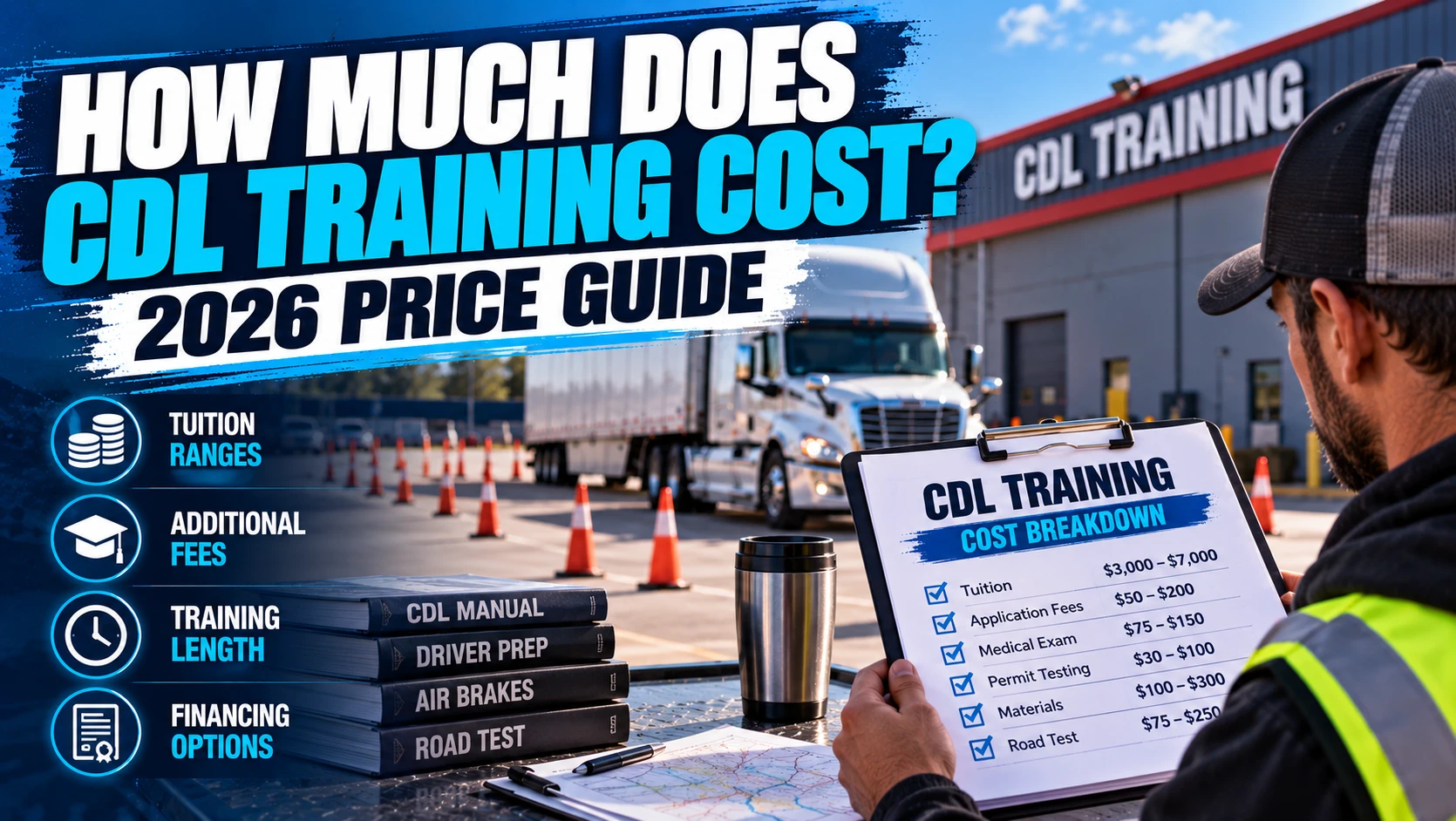
Published school guides give these typical ranges. They are not official government figures, and prices vary by state and school, so treat them as a starting point:
- Community colleges and technical schools: roughly $1,000 to $5,000 (some guides put the top end closer to $6,000).
- Private truck driving schools: roughly $3,000 to $10,000.
- Employer-sponsored training: often advertised as free or low-cost, but usually tied to a work commitment (see below).
Ranges like these come from school and training-industry guides such as this cost overview. Always get the exact price in writing from the school you are considering.
What does the price usually include?
Federal rules require first-time Class A applicants to finish entry-level driver training (ELDT) with a provider listed on the FMCSA Training Provider Registry before taking the state skills test. That training has two parts: theory (classroom or online) and behind-the-wheel instruction. The same rule applies if you are upgrading from a Class B to a Class A. Details are on the FMCSA ELDT page.
Many schools bundle theory, range and road practice, and sometimes a truck for your skills test. Others charge separately for some of these. Ask exactly what is in the sticker price.
What costs are not in the tuition?
Budget for these on top of tuition. Amounts vary by state, so check your state DMV for current fees:
- Commercial learner's permit (CLP) and CDL license fees
- The DOT medical exam and medical card
- Drug testing, if the school or employer requires it
- Study materials and any retest or extra practice fees
- Living costs while you are in class, especially if you cannot work
See our guide on how to get your CDL for the full step-by-step process.
How long does CDL training take?
The Bureau of Labor Statistics says training programs typically run 3 to 6 months at professional truck driving schools or community colleges. Many full-time programs are shorter, and part-time programs can take longer. A longer program is not automatically better. What counts is that you can pass the tests and operate the truck safely. Our post on how long it takes to become a truck driver goes deeper.
Worked example: comparing two programs
This is a hypothetical example to show the math, not a real school or price.
- Program A (community college): $3,200 tuition + $150 permit and license fees + $120 medical exam + $200 study and test costs = $3,670. It runs 8 weeks part-time, so you can keep working part of the time.
- Program B (private school): $6,000 tuition + the same $470 in fees and exams = $6,470. It runs 4 weeks full-time, so you start earning sooner.
The difference is $2,800. The question is whether finishing four weeks sooner would earn you more than $2,800. Ask what a first-year driver in your area realistically earns before you decide. Our jobs page shows current openings and what employers say about pay, and the match quiz can help you narrow down what to look for.
What about "free" CDL training?
Some employers pay for your training. This can be a good deal, but read the agreement carefully. Questions to ask:
- How long must you work for them after you get your CDL?
- What happens if you leave early? Do you owe money back, and how much?
- What will you be paid during training and during your first months?
- Is the training provider listed on the FMCSA Training Provider Registry?
Never sign something you have not read in full. If you are unsure about a contract, ask a qualified professional. Our drivers page has a checklist of questions to ask any employer.
Common mistakes when paying for CDL training
- Choosing only on price. A cheap program that does not give you enough truck time can leave you struggling on the skills test.
- Skipping the registry check. If the provider is not on the FMCSA Training Provider Registry, your training will not count for ELDT.
- Not asking about retest fees. Failing a skills test is common enough that you should know the cost before you enroll.
- Forgetting extra costs. Permit, license, medical exam and lost income add up.
- Not reading the sponsorship contract. The "free" price may come with a repayment clause.
Frequently asked questions
Can I get financial help for CDL school?
Some people qualify for help through state workforce programs, community college aid or veterans' benefits. Availability and rules differ by state, so ask the school's admissions office and your local American Job Center. This is general information; ask a professional about your own situation.
Is community college CDL training good enough?
Quality depends on the individual program, not the type of school. Check that it is on the FMCSA registry and ask about truck time, pass rates and how long the wait list is.
Do I have to go to school to get a Class A CDL?
For first-time Class A applicants, yes. You must complete ELDT from a registered provider before the skills test. See the FMCSA ELDT page.
How much do truck drivers earn after training?
The BLS reports a 2025 median pay of $58,640 per year for heavy and tractor-trailer drivers, with pay varying by employer, lane and experience. First-year pay is often lower than the median. No employer or school can promise a specific amount.
Where can I find a registered training provider?
Use the search tool on the FMCSA Training Provider Registry.
Free for CDL-A drivers: get our Job Offer Checklist — 23 questions to ask any carrier about pay, miles and home time before you sign. Download the free checklist →
Know a CDL-A driver looking for work? Refer them and earn $500 when they complete 30 days on the road. Refer a driver →
CDL Transportation Group | CDL-A OTR Driver Recruiting