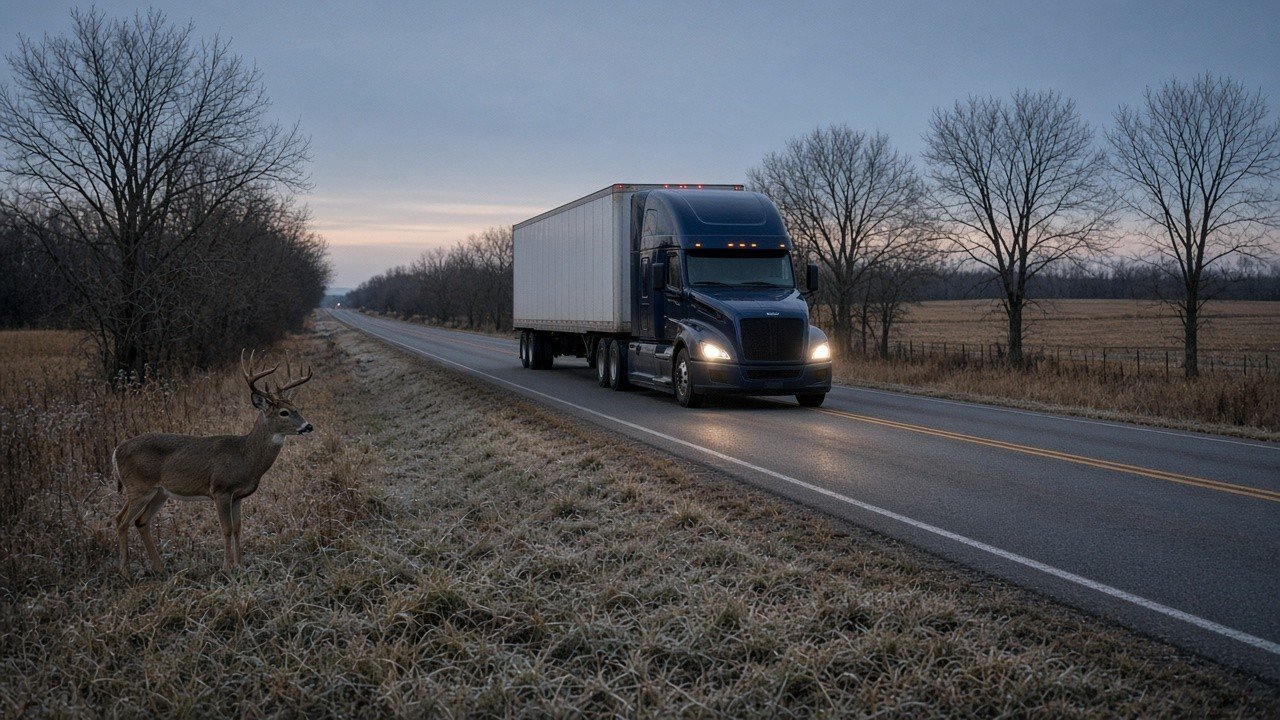
If you hit a deer in a semi, the safest move is usually to brake hard in a straight line, stay in your lane and hit the animal rather than swerve. Then get stopped safely, turn on your hazards, put out your triangles within 10 minutes, call your carrier and check the truck before you roll again. November is the worst month for it: insurance data from the Highway Loss Data Institute shows animal-strike claims in November run more than twice the yearly average, because the deer mating season keeps bucks on the move. Here is what CDL-A drivers should know this month, as of November 2026.
When and where are deer strikes most likely?
Deer are most active around dawn and dusk, which in November lines up with the hours many OTR and regional drivers are rolling in the dark. According to the HLDI's animal strike bulletin, claims rise in October, peak in November and drop off in December and January. West Virginia, Iowa and South Dakota had the highest November claim rates in its 2013 to 2022 data, and an earlier HLDI study also flagged Pennsylvania, Kentucky and Michigan.
Watch hardest on two-lane rural highways, interstates that cut through woods or farmland, and anywhere you see deer crossing signs. Hunting season adds to the movement, because hunters push deer out of cover during the day too.
Should I swerve to miss a deer in a semi?
In most cases, no. A loaded tractor-trailer at highway speed does not change direction cleanly. A hard swerve can jackknife the rig, roll it, put you into oncoming traffic or send you off the road. Hitting a deer usually means a damaged bumper, grille or radiator. Swerving can mean a rollover.
It also matters for your record. FMCSA's Crash Preventability Determination Program lists "CMV struck an animal" as a crash type your carrier can submit as not preventable. But the eligibility guide is clear that a crash caused by avoiding an animal, where you hit something else or leave the road, does not qualify.
- Brake firmly in a straight line and keep both hands on the wheel.
- Stay in your lane. Don't jerk the wheel.
- Lay on the horn. One long blast can sometimes move a deer off the road.
- Expect more than one. Deer often travel in groups, so a second or third one is common.
How much distance do I need to react?
Here is a hypothetical example to show why speed and scanning matter. At 65 mph you cover about 95 feet every second (65 x 5,280 / 3,600 = 95.3). If it takes you about 1.5 seconds to see the deer and get your foot on the brake, you travel roughly 143 feet before the brakes even start working (95.3 x 1.5 = 143). At 55 mph that drops to about 121 feet (80.7 x 1.5). Then the heavy truck still needs a long braking distance on top of that, and more on wet leaves or frost.
The takeaway: at night in deer country, slowing down a little and using your high beams whenever there's no oncoming traffic buys you real distance. Watch for eyeshine along the shoulder and the tree line, not just the lane in front of you.
What should I do right after hitting a deer?
- Get stopped safely. If the truck still drives normally, move to the shoulder, an exit or a safe pull-off rather than stopping in a travel lane.
- Hazards and triangles. Under 49 CFR 392.22, when you're stopped on the traveled lane or shoulder, turn on your four-ways right away and place your warning devices as soon as possible, and in any event within 10 minutes. On a two-way road that is one about 10 feet behind on the traffic side and one about 100 feet each way.
- Stay away from the deer. An injured deer can kick hard. Don't try to move it or finish it off.
- Call your carrier and, if needed, the police. Your safety department will tell you whether they want a police report. Reporting rules for animal strikes vary by state, and a report helps if the crash later goes to DataQs.
- Take photos. The truck damage, the road, the deer if it's still there, your mile marker and any skid marks.
- Inspect before you roll. Check the items in the next section, and don't drive on if anything vital is damaged.
What should I check on the truck after a deer strike?
Most deer strikes hit the front of the truck. HLDI found almost 9 out of 10 animal-strike claims were front-impact crashes. Do a walkaround with extra attention on:
- Radiator and coolant. Look for leaks under the front end and watch your coolant temperature closely once you're moving. A punctured radiator can overheat the engine within miles.
- Headlights and marker lights. You need working lights to drive legally at night, and a broken headlight in November means a lot of dark hours.
- Air lines and wiring behind the bumper and around the steer axle.
- Steer tires, wheels and suspension. Check for cuts, damage or anything bent.
- Hood, mounts and mirrors. A loose hood or mirror can come off at speed.
- Fluid on the ground. Oil, fuel, coolant or power steering fluid all mean stop and call it in.
If the truck needs a tow, that changes the paperwork, as explained below. If you're stuck waiting on a repair, check our truck stop finder and truck parking map to plan where you'll land.
Is hitting a deer a DOT recordable accident?
It can be. Under 49 CFR 390.5, an "accident" includes a crash where someone dies, someone is injured and immediately gets medical treatment away from the scene, or a vehicle is so damaged it has to be towed away. So a deer strike where you drive away with a cracked bumper usually doesn't meet that definition. A deer strike where the tractor gets towed because the radiator is destroyed generally does. Carriers must keep an accident register of these crashes for three years under 49 CFR 390.15.
If it is recordable, the good news is that an animal strike is one of the crash types your carrier can submit through DataQs to be marked not preventable in FMCSA's safety data, with the police report and photos as evidence.
Do I need a drug and alcohol test after hitting a deer?
Under federal rules, not usually. 49 CFR 382.303 requires a post-accident test when there's a fatality, or when there's an injury treated away from the scene or a tow-away and you get a citation for a moving violation from the crash. A deer strike rarely involves a citation. Your carrier's own policy may be stricter, so follow what safety tells you. If you want a refresher on how testing records work, see our guide to the Drug and Alcohol Clearinghouse.
Common mistakes
- Swerving at highway speed. It turns a repair bill into a rollover risk, and an avoidance crash isn't eligible for the not-preventable review.
- Driving on with a leaking radiator. A few more miles can cost an engine.
- Skipping the photos and report. Without them, it's much harder to show the crash wasn't preventable.
- Relying on deer whistles. There isn't solid evidence they work. Speed, scanning and high beams do more.
- Relaxing after the first deer. Where there's one, there are often more.
- Not telling your carrier right away. Late reporting makes their side of the paperwork harder, and some policies require an immediate call.
For more on staying safe this season, read our winter driving tips for OTR drivers. If you're thinking about a carrier with routes and home time that fit you better, our job match tool and current CDL-A jobs are a good place to start.
Frequently asked questions
What time of day do most deer strikes happen?
Dawn and dusk, when deer are most active. In November, that overlaps with darker commuting and driving hours.
Will hitting a deer hurt my CSA score?
Crashes show up in your carrier's safety data, and a recordable one can count against it. Animal strikes are eligible for FMCSA's Crash Preventability Determination Program, so your carrier can ask through DataQs to have it marked not preventable. Your personal PSP record lists crashes too.
Do I have to call the police after hitting a deer?
It depends on the state and the damage. Call your carrier first if it's safe; most safety departments want a police report for anything beyond minor damage.
Can I keep driving after hitting a deer?
Only if your walkaround shows no leaks, the lights, steering, tires and air lines are fine, and the gauges stay normal. If in doubt, stop and get it checked.
Does insurance cover a deer strike on a semi?
That depends on your carrier's or your own policy. Company drivers should let the carrier handle it; owner-operators should check their physical damage coverage. This is general information, so ask a qualified professional about your situation.
Know a CDL-A driver who wants a carrier that has their back? Refer them to us. It's free for drivers. Refer a driver here.
Free for CDL-A drivers: get our Job Offer Checklist — 23 questions to ask any carrier about pay, miles and home time before you sign. Download the free checklist →
Know a CDL-A driver looking for work? Refer them and earn $500 when they complete 30 days on the road. Refer a driver →
CDL Transportation Group | CDL-A OTR Driver Recruiting