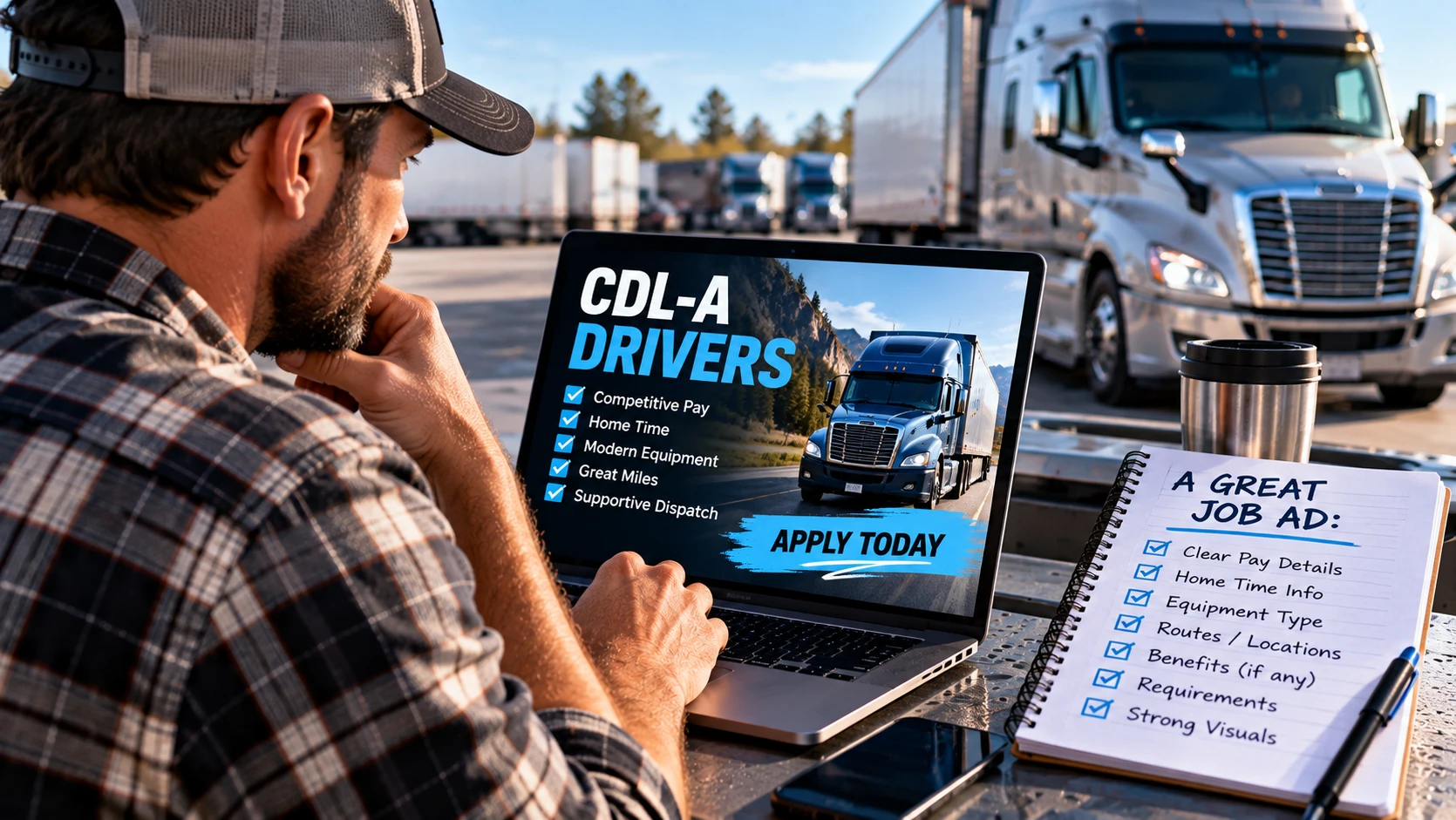
A truck driver job ad is the front door of your recruiting funnel, and most carriers leave it in bad repair. If your posting says "competitive pay, great home time, new equipment," an experienced CDL-A driver has learned to scroll past it. Every driver who scrolls past is a seat that stays empty while the payments keep coming due. Here is how to write a driver job ad that gets the right people to apply.
Why Vague Job Ads Cost You Applicants
Experienced drivers have read thousands of ads that all sound alike. Recruiting-industry analyses of trucking ads, such as this breakdown from Transforce, keep landing on the same causes of poor conversion: vague language, unclear pay, long applications and slow follow-up. Notice that only one of those four is about the ad copy alone. The rest are about what happens after the click, which is why a good ad is only the first part of the job.
Lead With the Four Things Drivers Actually Compare
When a driver is deciding between your ad and the next one, they are comparing specifics. Put these at the top, in plain words:
- Pay structure and realistic weekly earnings. Say "cents per mile, typical week $1,300 to $1,500 on 2,500 miles" rather than "up to $90,000." Only publish a typical-week number your current drivers really hit.
- Home time. "Home every other weekend" beats "great home time." If the schedule varies by lane, say so.
- Lanes and freight. Dry van, regional or OTR, drop-and-hook or live loads, touch freight or no-touch. Drivers filter hard on these.
- Equipment. Model years, transmission, and whether trucks are assigned to one driver or shared.
Pay transparency is also a retention tool. Drivers who quit in the first weeks very often leave because the job did not match the ad. Honest copy loses some clicks, but the applicants it does bring in are the ones likely to stay.
Write for One Driver, Not Every Driver
An ad that promises high pay, daily home time, low stress and flexibility all at once reads as unbelievable. Pick the driver you actually want, such as a regional dry-van driver with two years of experience who wants to be home weekends, and write to that person. Run separate ads for separate roles instead of one catch-all posting. A narrow ad gets fewer but better applicants, and your recruiters spend their time on calls that can turn into a seated driver.
Cut the Friction in Your Application
Every extra field loses applicants. Your first form needs name, phone number, CDL class, years of experience and best time to call. Collect the rest, such as employment history, MVR authorization and the DOT application, after you have spoken to the driver. Test the form on a phone, because most drivers apply from one. If it takes more than a couple of minutes, shorten it.
Speed to Contact Decides Who Gets the Driver
A driver who applies to your ad has usually applied to several others. The carrier that calls first, and calls a real person, tends to win the conversation. Set a hard internal target, for example every new applicant gets a call within 15 minutes during business hours and a text if there is no answer. Track it. If nobody owns that number, it will drift. Even a next-day callback can mean the driver has already accepted another offer.
Do the Math on What a Good Ad Is Worth
The cost side of the argument is simple. Driver compensation is already your biggest line item. According to the ATRI report covered by FleetOwner, the industry averaged $1.028 per mile on driver wages and benefits in 2025, out of a record $2.336 per mile in total operating cost. When driver pay is that large a share of your costs, paying more per mile is not the only lever. Writing the pay and the job honestly, and answering applicants fast, costs almost nothing and increases the number of qualified drivers you can choose from. Here is a worked example with assumptions you should replace with your own: if you spend $2,000 a month on ads and get 40 applicants, your cost per applicant is $50. If better copy and a shorter form lift that to 60 applicants from the same spend, the cost per applicant drops to about $33 before you have changed anything else.
A Quick Job Ad Checklist
- Is the pay structure and a typical weekly figure in the first two lines?
- Are home time, lanes, freight type and equipment stated specifically?
- Is the ad written for one type of driver?
- Does the application take less than two minutes on a phone?
- Will someone call every applicant within an hour?
- Does the job as described match what a driver will see in the first week?
Key Takeaways
- Replace "competitive pay" with a pay structure and a realistic typical week.
- Write one ad per driver profile instead of one ad for everybody.
- Keep the first application short and phone-friendly.
- Measure and enforce speed to first contact.
- Make sure the ad matches the real job, because mismatched expectations show up as early turnover.
When Your Team Can't Run All of This
Writing ads, answering every applicant within minutes, qualifying drivers and getting them to orientation is a full-time job. If your team does not have the hours to do it well, outsourcing the recruiting is a reasonable option, as long as the pricing is tied to a driver actually being seated.
Need CDL-A Drivers? We Recruit Them for You.
CDL Transportation Group finds, qualifies, and delivers CDL-A OTR company drivers all the way to your orientation. No retainers, no setup fees, and no ad spend on you — you pay $2,000 per seated driver, split into two $1,000 payments, backed by a replacement guarantee.
Tell us how many drivers you need →
CDL Transportation Group | CDL-A OTR Driver Recruiting