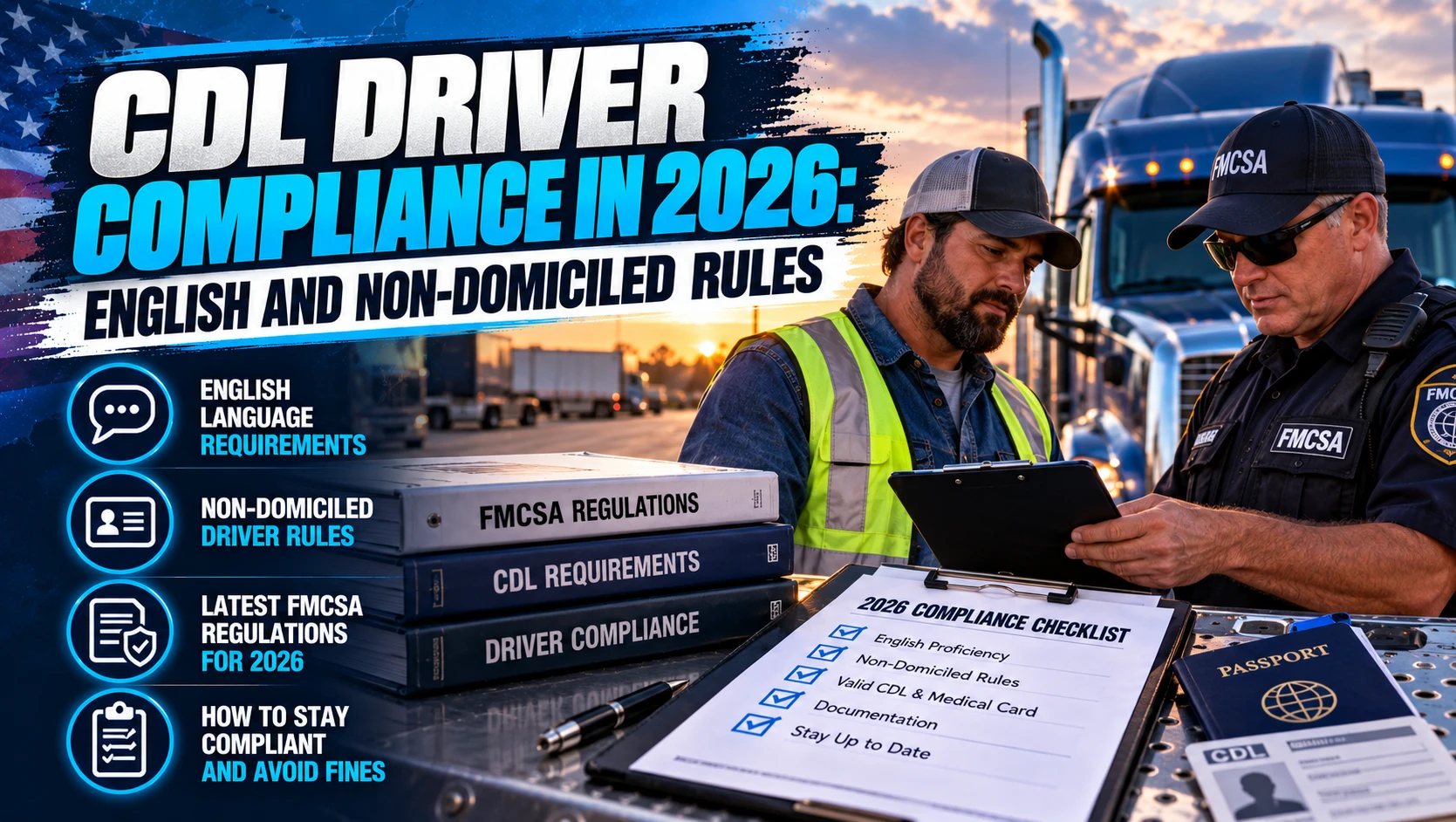
Two federal rules are changing who you can legally put behind the wheel: English language proficiency (ELP) enforcement and the new non-domiciled CDL restrictions. If you hire CDL-A drivers, CDL driver compliance is no longer something that lives only in the safety department. It decides whether a new hire can actually run your truck, or whether the truck sits at a roadside inspection while freight waits. Here is what changed, what is still proposed, and what to fix in your hiring process now.
English proficiency: from guidance to a rule
The requirement itself is not new. Under 49 CFR 391.11(b)(2), a driver must be able to read and speak English well enough to converse with the public, understand traffic signs and signals, respond to official inquiries and make entries on reports and records. What changed is enforcement. After an April 2025 executive order, the Commercial Vehicle Safety Alliance added ELP to the North American Standard Out-of-Service Criteria effective June 25, 2025, according to the summary of the rulemaking on the FMCSA website.
In August 2026 FMCSA proposed to write that practice into the regulations so a failed ELP check is an explicit out-of-service violation nationwide, with an exception for drivers whose trip stays inside the U.S.-Mexico border commercial zones. FreightWaves reports that more than 26,000 drivers have been sidelined since strict enforcement returned, and that the proposal is still in its public comment stage. Treat the proposal as a signal of direction, but the enforcement is already happening on the road today.
What an ELP out-of-service order costs you
The driver is stopped at the roadside and cannot continue until the issue is resolved. In practice that means a power unit and a load stuck in place, a recovery driver or a late delivery, and an inspection on your safety record. Put your own numbers on it: take your weekly gross per truck, divide by seven, and add the cost of whoever has to pick up the freight. One failed check can easily cost more than the screening that would have prevented it.
Non-domiciled CDLs: much narrower eligibility
The second change is the final rule on non-domiciled CDLs, which took effect in March 2026. Per Trucksafe's summary, eligibility is limited to holders of H-2A, H-2B and E-2 visas. The credential term follows the driver's immigration documents and cannot run longer than one year, and state licensing agencies must verify status through the federal SAVE system.
The same summary notes that FMCSA expects the effect on the existing driver pool to be gradual, because most current non-domiciled licenses run for years and the population shrinks as they expire and are not renewed. For you, that means a driver who is valid today may not be able to renew, so expiration dates matter as much as the license class.
Seven changes to make in your hiring process this month
- Screen language early. Have a recruiter talk to every applicant by phone before you pay for an MVR or PSP. Ask them to describe a trip in their own words and to read a short dispatch message. This takes five minutes and is a legitimate way to check the same abilities an inspector will test.
- Document it. Add a short, consistent note to every driver file showing how and when you assessed English ability. Apply the same standard to every applicant so your process is fair and defensible.
- Flag non-domiciled licenses at application. The word "Non-domiciled" is printed on the face of the license. Add a checkbox to your application and route those candidates to a manual review of their immigration documents and expiration dates.
- Track expirations. Put the license expiration and the immigration document end date in the same tracker you use for medical cards, with alerts at 90 and 30 days.
- Run the Clearinghouse query before orientation. A prohibited driver who flies in for orientation is a wasted ticket and a wasted week.
- Audit your current roster. Pull every driver with a non-domiciled license and confirm the status and renewal date. Plan replacement timelines for drivers who may not be able to renew, so you are never forced to park a truck overnight.
- Brief your dispatchers and trainers. If a driver is stopped for an ELP issue, everyone should know who to call and what to do with the load.
Do not turn compliance into discrimination
Language and immigration screening must be applied to the job requirement, not to a person's accent, name or appearance. Use the regulation's actual criteria, apply them to every candidate the same way and ask your employment attorney to review your process. This article is general information, not legal advice.
The hiring math has changed
Every rule that removes drivers from the eligible pool makes the remaining qualified, English-proficient, properly licensed drivers more valuable. Slow follow-up and weak offers cost more when there are fewer candidates to choose from. Tighten your speed to contact, your pay clarity and your orientation experience, because the drivers you do reach have more options.
Key takeaways
- ELP is already an out-of-service item in the CVSA criteria; FMCSA's August 2026 proposal would write that into the federal regulations.
- Non-domiciled CDL eligibility is now limited to H-2A, H-2B and E-2 visa holders, with credentials tied to immigration documents.
- Screen for both early, document consistently and track expiration dates alongside medical cards.
- Audit your current roster now so renewals do not surprise you.
- Apply every standard to every applicant and have counsel review your process.
When your recruiters cannot keep up
Adding screening steps takes recruiter time, and a smaller eligible pool means more calls per hire. If your team does not have the capacity to source, pre-screen and follow up fast, outsourcing the top of the funnel is worth a look. Whoever does the work, build the compliance checks in before the driver arrives at orientation.
Need CDL-A Drivers? We Recruit Them for You.
CDL Transportation Group finds, qualifies, and delivers CDL-A OTR company drivers all the way to your orientation. No retainers, no setup fees, and no ad spend on you — you pay $2,000 per seated driver, split into two $1,000 payments, backed by a replacement guarantee.
Tell us how many drivers you need →
CDL Transportation Group | CDL-A OTR Driver Recruiting