Most carriers put real effort into vetting a driver at hire, then let the file sit untouched until an auditor asks for it. That gap is where problems hide: a new speeding conviction, a suspended license or a drug and alcohol violation reported by another employer. A disciplined annual driver review closes that gap, keeps your driver qualification files audit-ready and tells you early which drivers need coaching before they turn into a claim.
This guide covers what the federal rules actually require every 12 months, how to run the review without it eating your safety manager's week, and how to use the results to keep good drivers in the seat.
What the annual driver review requires
Two federal requirements drive the annual cycle for CDL-A company drivers:
- Annual MVR inquiry and review. Under 49 CFR 391.25, at least once every 12 months you must pull the motor vehicle record for each driver you employ, covering at least the preceding 12 months, from every licensing authority where the driver held a CMV license or permit during that time. You must then review it to decide whether the driver still meets minimum safe-driving requirements or is disqualified under 391.15.
- Annual Clearinghouse query. Under 49 CFR 382.701(b), you must query the FMCSA Drug and Alcohol Clearinghouse at least once a year for every employee subject to drug and alcohol testing.
One thing you no longer need: the driver's annual list of violations. FMCSA rescinded 49 CFR 391.27, effective May 9, 2022, because it duplicated the annual MVR pull. If your onboarding packet or annual checklist still asks drivers to sign a certificate of violations, you can drop it and save everyone a form.
Step 1: Pull the MVR from every licensing authority
The rule is not "pull one MVR from the current state." It is every licensing authority where the driver held a CMV license or permit in the past year. A driver who moved from Indiana to Texas in March needs records from both. The same 2022 rule change replaced "State" with "licensing authority," which means drivers licensed in Canada or Mexico need the equivalent record from that authority.
Practical tips:
- Ask each driver at review time whether they held a license anywhere else in the past 12 months, and note the answer.
- Check that the MVR actually covers the full 12-month look-back. A record pulled too narrowly does not satisfy the rule.
- Read the medical certification status on the CDLIS MVR while you have it open. 49 CFR 391.51(b)(6)(ii) ties CDL drivers' medical certification proof in the qualification file to that record.
Step 2: Actually review it, and document who did
Pulling the record is only half the requirement. Section 391.25(b) says you must consider any evidence the driver violated the safety regulations, consider the accident record and moving violations, and give "great weight" to violations such as speeding, reckless driving and operating under the influence. Then 391.25(c) requires two things in the qualification file: a copy of the MVR and a note with the name of the person who did the review and the date.
An MVR stapled into a file with no review note is one of the easiest findings an auditor can write up. Use a one-page review form with:
- Driver name, license number and every state or authority checked
- Convictions and accidents found in the past 12 months
- Decision: qualified, qualified with coaching, or disqualified
- Reviewer's printed name, signature and date
Step 3: Run the Clearinghouse annual query
For current drivers, a limited query satisfies the annual requirement. It only tells you whether information exists in the driver's record, and the driver's consent can be collected outside the Clearinghouse. Under 382.701(b)(2), a driver can sign a limited-query consent that is effective for more than one year, so a multi-year consent form at hire saves you chasing signatures every year.
If a limited query comes back showing information, the clock starts. You must run a full query within 24 hours, and that requires the driver's electronic consent inside the Clearinghouse. If you miss the 24-hour window, the driver cannot perform safety-sensitive work until the full query confirms no prohibition (382.701(b)(3)).
Two details worth knowing:
- Timing is rolling. FMCSA tracks the annual query on a rolling 365-day basis from the last query. A driver whose pre-employment query ran on March 10 is due again by March 10 next year.
- Cost is small. FMCSA charges a flat $1.25 per query, limited or full, and a limited query followed by a full query is billed once. A 20-truck fleet with 20 drivers would spend $25 a year on annual queries. Budget for MVR fees separately, since those vary by state.
Keep in mind that 382.701(e) requires you to keep a record of each query and its results for 3 years; a valid Clearinghouse registration fulfills that requirement as of January 6, 2023.
Step 4: Pick a schedule that cannot slip
Carriers usually choose one of two approaches:
- Hire-date anniversary. Each driver's review is due 12 months after their hire date. Workload spreads evenly across the year, but you need a reliable tracker so nobody falls through.
- Single review month. Everyone is reviewed in the same month. Easy to remember, but the first cycle has to be run early enough that no driver goes past 12 months since their last check.
Whichever you choose, set reminders at 60 and 30 days before each due date, and have a second person check the tracker monthly. For a small fleet, a shared spreadsheet with hire date, last MVR date, last Clearinghouse query date and next due date is enough. Since MVR reviews and Clearinghouse queries can fall on different dates, track them in separate columns.
Step 5: Use the review to coach and retain, not just to file
The annual review is also one of the few scheduled one-on-one moments with a driver who is doing fine. Use it:
- Share the result with the driver. A clean record is worth a thank-you; a new ticket is a chance to coach before it becomes a pattern.
- Set a written policy in advance for what triggers coaching, probation or removal, so decisions feel consistent rather than personal.
- Pair the review with a short conversation about routes, home time and equipment. Problems that surface here are cheaper to fix than a resignation.
Retention: how long to keep the records
Per 49 CFR 391.51(c) and (d), the driver qualification file must be kept for as long as the driver works for you and for three years after they leave. Annual MVRs and review notes may be removed three years after the date they were executed. Purging old annual records on that schedule keeps files lean without dropping anything an auditor can still ask for.
Key takeaways
- Pull an MVR at least every 12 months from every licensing authority the driver held a CMV license with in that period, and keep a copy in the DQ file.
- Document the review: reviewer's name and date are required, not optional.
- Run an annual Clearinghouse limited query on a rolling 365-day basis; a hit means a full query within 24 hours.
- The annual list of violations (391.27) was eliminated in 2022; stop collecting it.
- Use the review as a coaching and retention touchpoint, not just paperwork.
Keeping your seats filled with qualified drivers
A clean annual review process protects the drivers you already have. The harder part for most fleets is replacing the ones who leave with drivers whose records will pass the same standard. If your team doesn't have the time to source, screen and qualify new CDL-A drivers while also keeping compliance current, outsourcing the recruiting side lets your safety staff focus on the files that matter.
Have a CDL-A driver in mind who'd be a great fit somewhere new? Send them our way: Refer a driver.
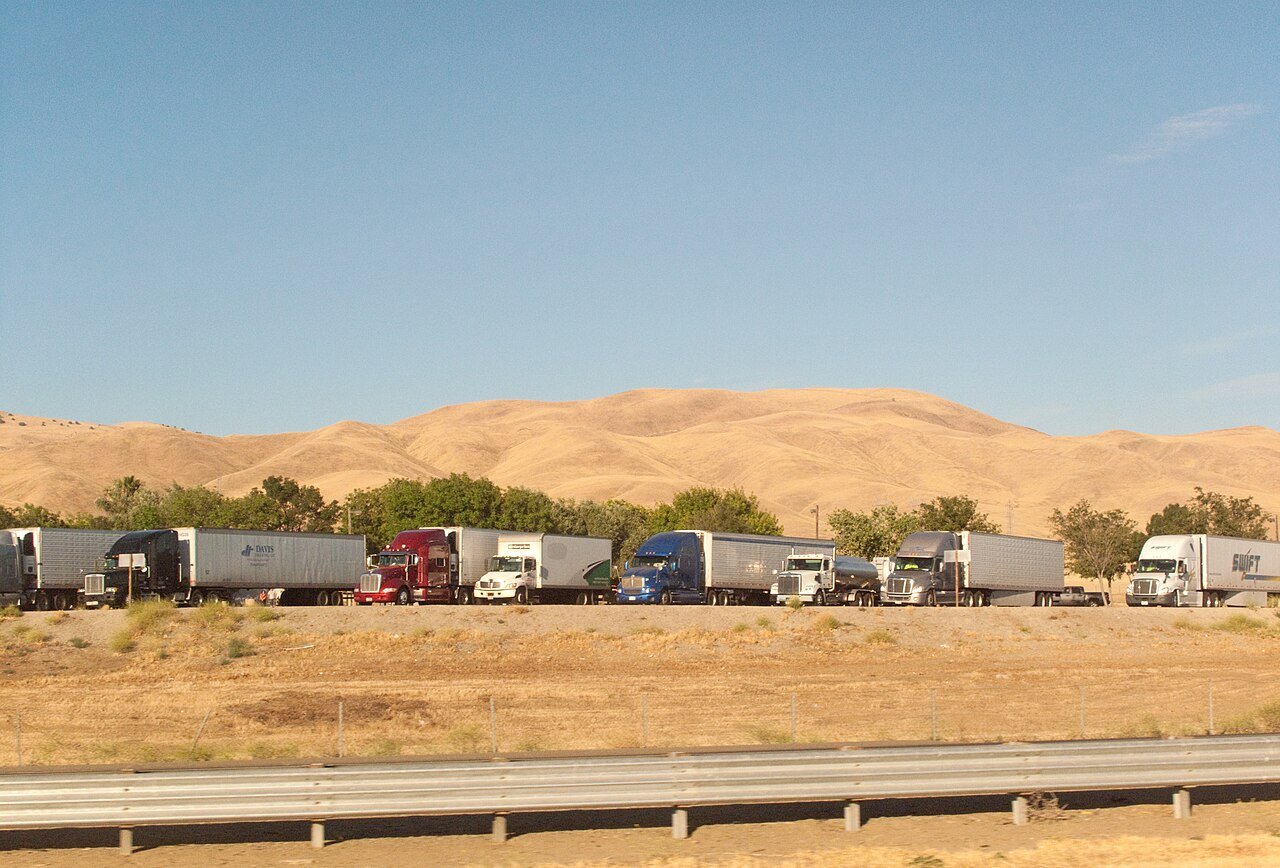
Photo: DanTD, CC BY-SA 4.0, via Wikimedia Commons.
Need CDL-A Drivers? We Recruit Them for You.
CDL Transportation Group finds, qualifies, and delivers CDL-A OTR company drivers all the way to your orientation. No retainers, no setup fees, and no ad spend on you — you pay $2,000 per seated driver, split into two $1,000 payments, backed by a replacement guarantee.
Tell us how many drivers you need →
CDL Transportation Group | CDL-A OTR Driver Recruiting