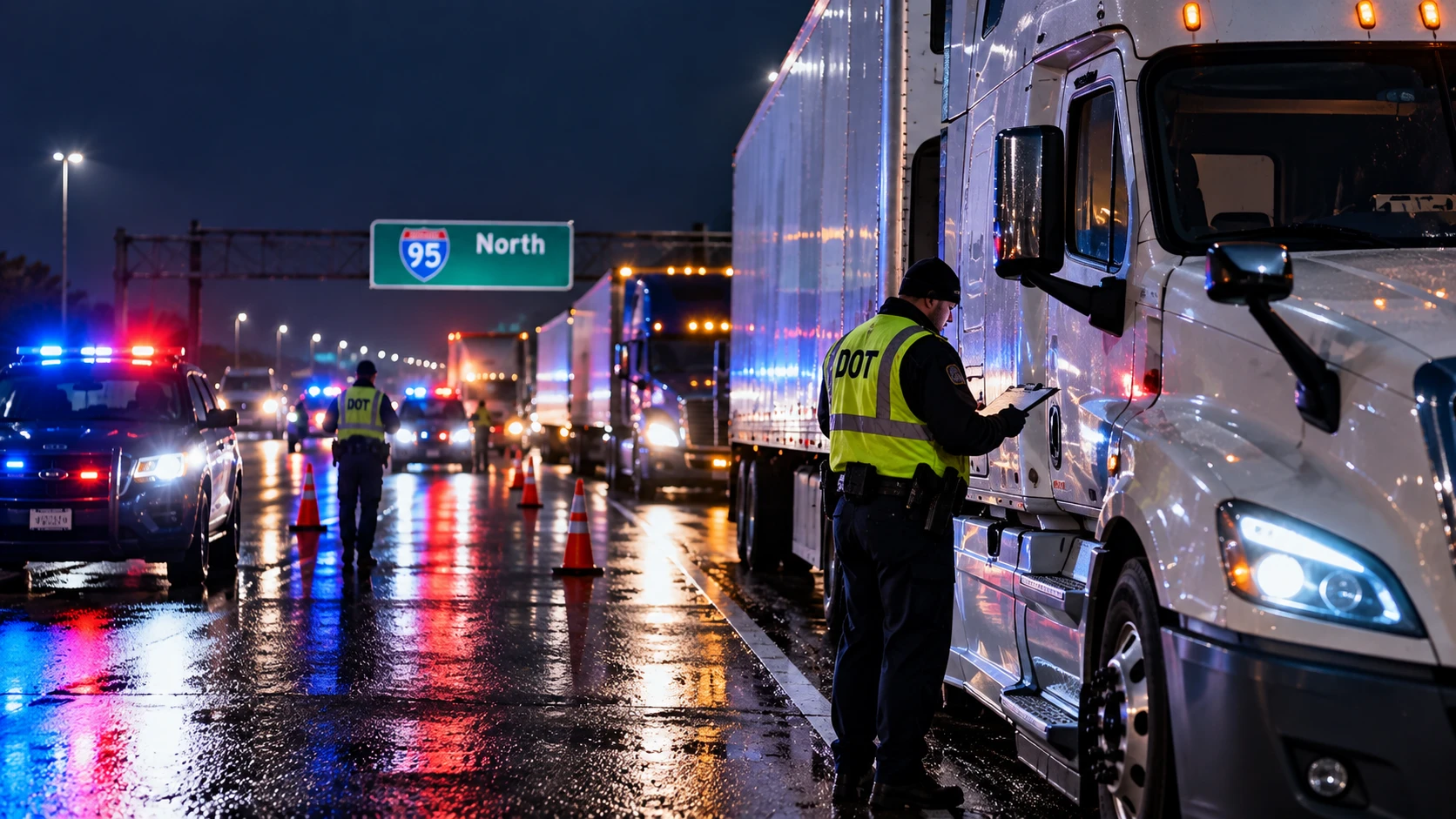
If you ran I-95 through the Carolinas, Georgia or Florida on the night of Saturday, September 26, you may have seen blue lights and a long line at a pullout. Federal and state officers ran a coordinated overnight sweep called "Operation Saturday Night Fever," and the results are a clear signal of where enforcement is heading this fall.
What happened
According to CDLLife's report on the FMCSA announcement, the Federal Motor Carrier Safety Administration teamed up with the Department of Homeland Security and state police agencies in South Carolina, North Carolina, Florida and Georgia. Officers carried out 552 commercial vehicle inspections during the operation.
The outcome: 78 drivers and 25 vehicles were placed out of service. Twelve of those drivers were cited for English language proficiency (ELP) violations, and non-domiciled CDL holders were among those pulled off the road. Other coverage of the sweep, including Tampa Free Press, also described Florida troopers joining the effort along I-95.
What inspectors were checking
This was not just a paperwork check. Officers looked at:
- Driver credentials, including the type and status of your CDL
- Fatigue and hours-of-service compliance
- Electronic logging devices (ELDs)
- Distracted driving, such as phone use behind the wheel
- Cargo securement
- English language proficiency
If your logs, license and load are all in order, none of that is a problem. But an overnight inspection with this many items on the list will find a bad ELD setup, a loose strap or a missing document quickly.
Why nights, and why I-95
Officials said the timing was deliberate. South Carolina State Transport Police Colonel Dwayne Wilson noted that nighttime hours are when dangerous driving behavior often goes unnoticed. Georgia's Major Andrew Montgomery pointed out that unsafe carriers do not respect state lines, which is why multi-state cooperation along corridors like I-95 matters. North Carolina State Highway Patrol Colonel Freddy L. Johnson, Jr. called agency cooperation "indispensable."
FMCSA Administrator Derek D. Barrs said safety comes first and that people who put the public at risk will be held accountable.
Not a one-off
This sweep fits a pattern. The Department of Transportation has run joint operations with DHS under the "Operation Highway Shield" banner, and Florida agencies have reported thousands of commercial vehicle inspections in multi-day operations earlier this year (see the FDLE announcement). Expect more of these, especially along major freight corridors and at night or on weekends, when drivers may assume fewer officers are out.
One caution: out-of-service numbers from an operation like this reflect targeted enforcement, not a random sample of all truckers. Most drivers who were inspected were not put out of service, so do not read these numbers as the share of drivers on the road who have problems.
Why a day out of service costs more right now
The timing makes any lost day more painful. EIA's weekly update put the national average for on-highway diesel at $6.382 a gallon on September 28, down about 15 cents from the prior week's record of roughly $6.53, according to IndexBox's summary of the EIA data. Even with that dip, fuel is eating a big share of every load, and DAT's September 13-19 report, published by AJOT, showed van spot rates at $2.96 a mile. When margins are this tight, a downed truck or a driver parked for a violation can wipe out a week of profit.
The bigger lesson is that a violation is not just a fine. An out-of-service order means your truck sits, your load is late, and the violation can follow your record and your carrier for a long time. Prevention is far cheaper than fixing it afterward.
What this means for you
- Check your ELD before you roll. Make sure it is on the current FMCSA registered list and that you have the output file instructions in the cab.
- Keep your paperwork together. CDL, medical card, registration, insurance and any permits should be easy to hand over in seconds.
- Know the ELP standard. You need to be able to speak with officers, understand highway signs and respond to questions. Our blog guide to English proficiency explains what inspectors look for.
- Do a quick securement walk-around. Straps, chains, tarps and doors are the easy tickets at night when you are tired.
- Stay off the phone. Distracted driving was a named focus. Hands-free or park it.
- Stay rested. Fatigue was on the checklist, and a tired driver makes mistakes that cost more than a late load.
- Check your license status. If you hold or are applying for a non-domiciled CDL, confirm with your state licensing agency that it is valid. For rules, rely on the official FMCSA site.
Fuel is already squeezing margins, so a day lost to an out-of-service order hurts more than ever. Check today's diesel prices and truck stop map when you plan your route, and run clean, no matter what time of night you are rolling.
Clean logs, a clean truck and a clean license are the cheapest insurance you can carry through the Southeast corridor this fall.
Free for CDL-A drivers: get our Job Offer Checklist — 23 questions to ask any carrier about pay, miles and home time before you sign. Download the free checklist →
Know a CDL-A driver looking for work? Refer them and earn $500 when they complete 30 days on the road. Refer a driver →
CDL Transportation Group | CDL-A OTR Driver Recruiting