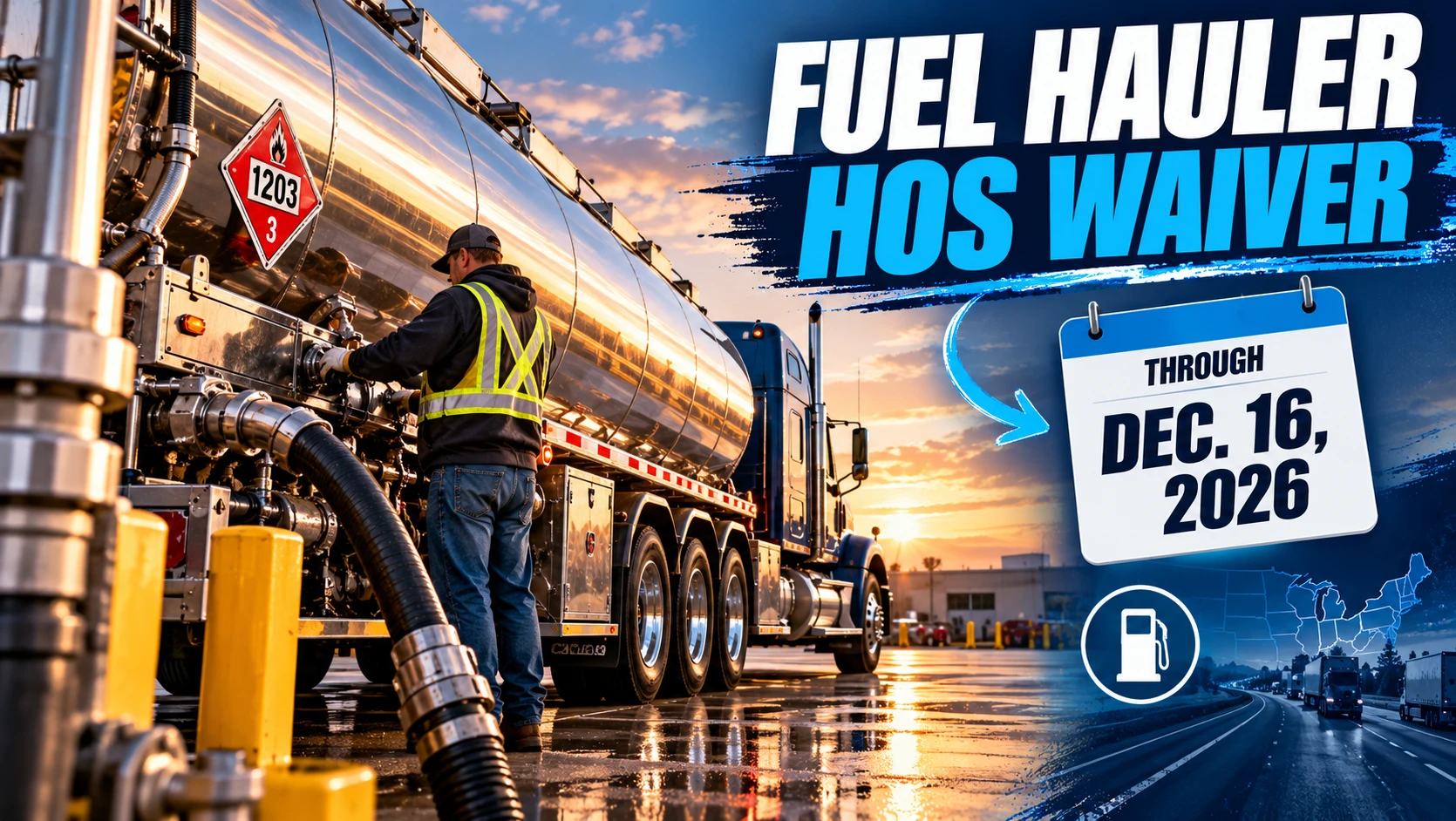
If you haul gasoline or diesel, your clock just got longer. If you don't, you're still affected, because the reason behind it is the same one hitting your fuel receipts. FMCSA has granted a 90-day hours-of-service waiver for fuel haulers, and it runs until mid-December. Here's what it actually says and what it doesn't.
What FMCSA granted
The waiver took effect September 16, 2026 and is scheduled to expire December 16, 2026, according to reporting on the FMCSA announcement. It covers interstate transportation of gasoline and diesel fuel. FMCSA said it acted because of global supply disruptions and expected late-summer and fall demand, with the goal of easing fuel costs and availability for carriers, farm harvest hauling and the traveling public.
The 16-hour window
Qualified drivers hauling fuel can work within a 16-hour window in a 24-hour period instead of the usual 14-hour window, Service Truck Magazine reports. That is a two-hour extension of the on-duty window, not a license to skip rest. Look at the rest rules attached to it:
- Drivers with a sleeper berth must take at least 6 consecutive hours in the berth during the 24-hour period.
- Drivers without a sleeper berth must take at least 8 consecutive hours off duty.
- A driver who asks for immediate rest must be allowed to get to a safe place first and rest.
- When the driver goes back to normal operations, a 10-hour break is required.
Who qualifies and who doesn't
The relief is not automatic for everyone. Under the waiver terms, you need a valid CDL with the proper endorsements, and you can't be under an out-of-service order, disqualified, or have lost driving privileges. Carriers with a conditional safety rating are excluded, as are carriers under an out-of-service order. The waiver also requires a physical or digital copy to be available while you operate, so keep it on your phone or in the cab. CCJ also covered the grant.
Carriers have obligations too. They must report qualifying crashes to FMCSA within two business days and keep watching for driver fatigue and vehicle safety, per the same coverage.
Why this is happening now
Diesel has been brutal. EIA's weekly survey put the national average at $6.382 per gallon on September 28, down from $6.529 the week before, which was the highest in the agency's 32 years of tracking diesel, according to Logistics Management. That first weekly drop in 12 weeks is welcome, but prices are still about $2.63 above where they were a year ago. You can check today's diesel prices and truck stop map before you fuel.
The waiver is a supply-side move: more hours from the drivers already moving fuel means more gallons reaching terminals and stations. It does nothing for your price per gallon on its own. Fuel is also a safety-critical load, and longer days come with more fatigue risk, which is why the rest minimums are written into the waiver.
What it does not do
This is not a general hours-of-service change for dry van, reefer or flatbed drivers. If you are not hauling gasoline or diesel, your normal 14-hour window still applies. Don't assume a dispatcher's casual "FMCSA loosened the rules" applies to your load. Also note that sources describe a waiver, which is temporary and can be ended or not renewed, unlike a rule change. FMCSA's separate 2027 hours-of-service pilot programs are a different story from this one.
Fatigue is the real tradeoff
Extra hours in a day look good on a paycheck, but fatigue is the tradeoff FMCSA itself wrote guardrails around. That is why the waiver ties the longer window to the 6-hour sleeper or 8-hour off-duty minimums, lets a tired driver stop and rest, and tells carriers to watch for fatigue. If you drive fuel, treat those as the minimum. A longer legal window only helps if you're alert for all of it, and you are the one who decides whether to keep rolling.
Pay is the other question. A longer window doesn't automatically mean more money, especially if you're paid by the mile or by the load. Ask your carrier how the waiver changes your dispatch before assuming it helps your weekly check.
What this means for you
- Tanker drivers: read the actual waiver text and make sure your carrier qualifies before you stretch a day.
- Know your own limit. Legal and safe are different things. A 16-hour window is long, so use the rest requirements as a floor.
- Check the carrier. A conditional safety rating means no relief, so ask before you sign on for fuel work.
- Think about the demand. Fuel hauling is in the spotlight right now. If you've been thinking about tanker work, ask carriers how they handle the waiver and what they pay for it before you commit.
- Mark December 16. Plan on the waiver ending unless FMCSA says otherwise.
For the exact legal language, go to the official FMCSA waiver notice on fmcsa.dot.gov rather than relying on a summary, including this one.
Know your clock, know your carrier, and don't let a longer window shorten your rest.
Free for CDL-A drivers: get our Job Offer Checklist — 23 questions to ask any carrier about pay, miles and home time before you sign. Download the free checklist →
Know a CDL-A driver looking for work? Refer them and earn $500 when they complete 30 days on the road. Refer a driver →
CDL Transportation Group | CDL-A OTR Driver Recruiting